ProjectionLab's growth teardown: the continuity gate and the vouch you can't buy
How a solo developer reached $1M ARR with no funding, no ads and no SEO team by giving away the whole engine and charging only to save your work, and which of those mechanics survive the move to B2B.
ProjectionLab is not a B2B company. It is a consumer retirement planner sold to individuals at $129 a year, and we should say that in the first line rather than quietly hope you do not notice. We are tearing it down anyway, for two reasons. The pricing mechanic underneath it is one of the cleanest examples of a transferable freemium design you will find. And the part of the story everybody repeats, the launch, turns out to be the part that does not transfer at all.
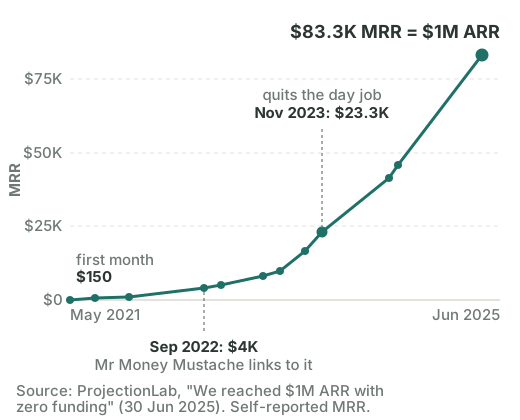
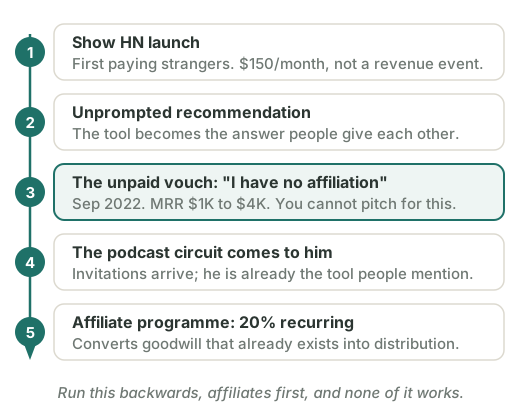
ProjectionLab reached $1M ARR in four years with no funding, no ads and no SEO team by giving away the entire simulation engine and charging only to save your plan. Distribution was earned, not bought: a Hacker News launch, then an unpaid link from the most trusted voice in its niche, then the podcast circuit that followed from it.
Where ProjectionLab landed by June 2025
How ProjectionLab grew, dated
What ProjectionLab actually sells
Here is the mechanic worth the whole teardown, and it is not the one usually cited.
Most freemium products gate capability. The free tier is a weaker version of the product, and you pay to make it stronger. ProjectionLab did the opposite. The free tier carries the full engine: forecasting, Monte Carlo simulations, historical backtesting ProjectionLab pricing. What you pay for is that your work still exists tomorrow. The founder described his own pricing on Hacker News in April 2022 as "client-side by default, no persistence in the free tier" Founder, Show HN (Apr 2022).
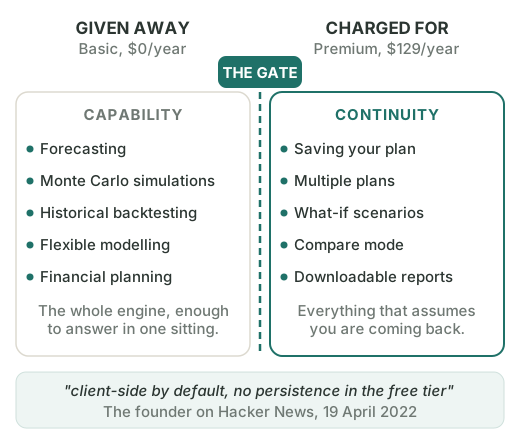
Why this works is worth being precise about, because it is the transferable part. Gating capability puts virality and revenue in direct conflict: every limit you add to make people pay also makes the free product less worth showing anyone. Gating continuity puts them on different axes. The free tier stays fully demonstrable, so it survives being passed around, and the wall arrives on the second visit, when someone returns to update a model they have already put an hour into. The willingness to pay is manufactured by the user's own invested effort, not by withholding features.
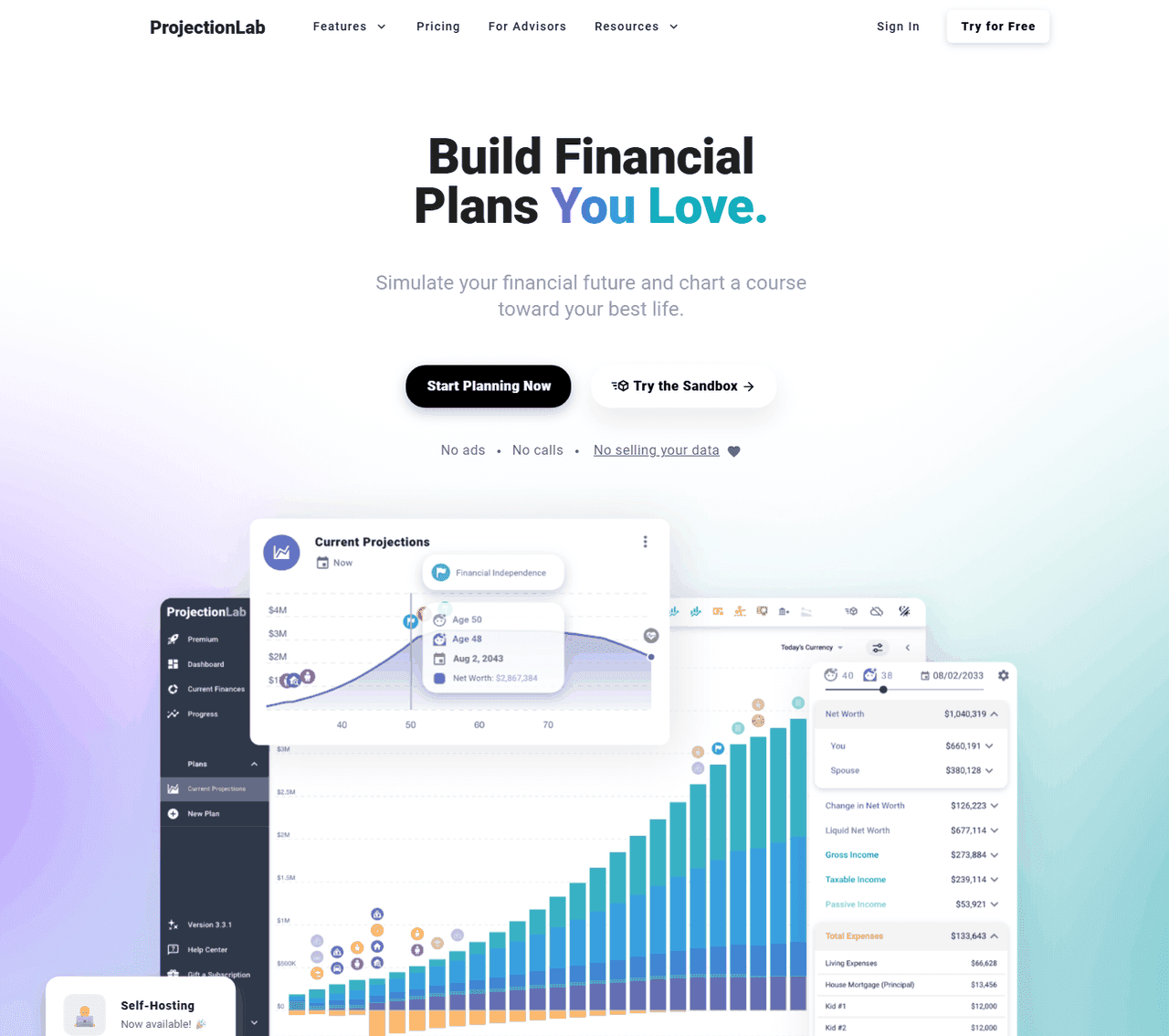
That only works where the value is genuinely iterative. Retirement planning qualifies: the whole point is revising the model as your life changes. Before copying it, ask whether your product is returned to or merely used once. Our guide to free trial, freemium and reverse trial walks the choice, and freemium conversion benchmarks give you the range to expect.
How it got its first users, honestly
The story is usually told as a Hacker News success. The full record complicates that considerably.
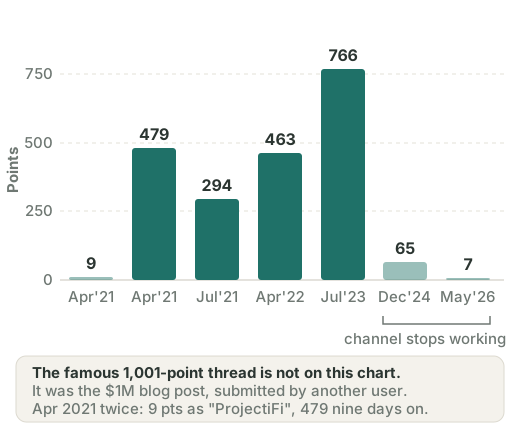
Three things in that chart get left out of the retelling. The first launch, under the name ProjectiFi, scored 9 points. Nine days later the same product, at the same URL, with a plainer title, scored 479 Hacker News. The fix that worked was the headline, before any rebrand.
Second, it decayed. The 2023 post scored 766 points; the December 2024 post scored 65, and a May 2026 post scored 7 Hacker News. The same founder, the same channel, a better product each time.
Third, the famous 1,001-point thread was not a Show HN and was not his. It was his $1M blog post, submitted by a different user Hacker News. His own submission of that identical URL, a week earlier, scored 2 points.
And the launch that did work was not a revenue event. It converted to $150 MRR in the first month ProjectionLab. What it bought was evidence that strangers would pay, and a first cohort of people who cared.
The vouch you cannot buy
In September 2022 the most trusted voice in the financial independence niche posted: "I have no affiliation to the project, but it's rare to see something so well-made by an indie developer" Mr Money Mustache, Sep 2022 Med.
The disclaimer is the entire asset. An arms-length endorsement from someone with no stake is worth more than any sponsorship precisely because it cannot be bought, which also means it cannot be added to your plan. The podcast circuit followed, including ChooseFI ChooseFI Ep. 506 Med, and a 20% recurring affiliate programme came later ProjectionLab affiliates.
The numbers, and the ones that do not exist
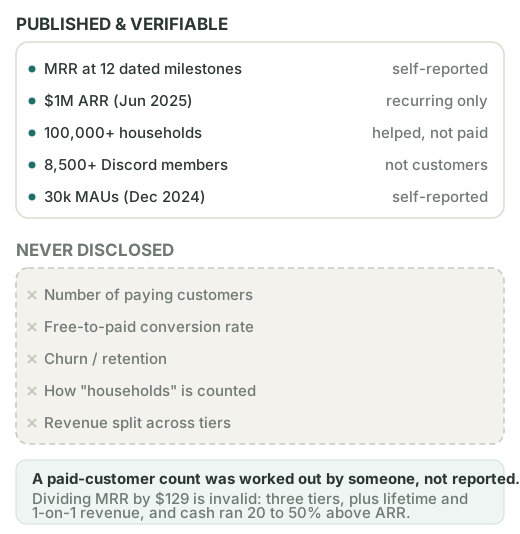
This is where most retellings quietly invent things, so it is worth being exact about what ProjectionLab has actually disclosed.
| Figure | What it counts | As of | Source |
|---|---|---|---|
| $1M ARR | recurring revenue only | Jun 2025 | company post |
| 100,000+ | households helped, not customers | Jun 2025 | company post |
| 8,500+ | Discord members | Jun 2025 | company post |
| 30k | monthly active users, self-reported | Dec 2024 | founder, Hacker News |
| 20-50% | monthly cash above the ARR run rate | Jun 2025 | company post |
"Over 100,000 households" counts households the product has helped. It is not a customer count, and it is not comparable to the MRR figures. ProjectionLab has never published a paid-user number, a conversion rate or a churn rate. If you see one quoted, someone worked it out. You cannot recover it by dividing MRR by $129 either, because there are three tiers plus lifetime and one-to-one revenue, and monthly cash ran 20 to 50 percent above ARR ProjectionLab.
That last figure is the one bootstrappers should notice. Non-recurring income, lifetime licences and paid one-to-one sessions, meant the business ran on materially more cash than its ARR implied, which is how it funded growth without raising. Note the tense carefully: lifetime demonstrably existed and mattered in June 2025, and as of 31 July 2026 no lifetime plan appears on the pricing page at all ProjectionLab pricing, checked 31 Jul 2026. We are not going to tell you why, because ProjectionLab has not said.
What you can't copy, and what moves to B2B
The reason this sits on a B2B site is that the mechanics split cleanly, and the split is the useful part.
Transfers to B2B. The continuity gate is the strongest of them: give away capability, charge for persistence, history, collaboration and export. It works in any product a team returns to. Constraint as positioning transfers too. ProjectionLab refuses to link bank accounts, which is both a trust wedge against incumbents whose free tools are lead generation for a sales team, and cheaper to run. Find where the incumbent's business model quietly works against its user and make the opposite your position. Stacking non-recurring revenue on a subscription is a bootstrapper's tool in any category.
Does not transfer. The single-authority recommendation graph is a consumer-community feature. B2B buyers rarely have one Mr Money Mustache whose word moves a whole market, so the vouch mechanic generalises only to the rare B2B niche with a genuinely dominant independent voice. Ideological pricing, a lifetime licence sold to an audience that is philosophically hostile to recurring fees, depends on a shared belief system that B2B buyers with expense budgets do not have.
And what nobody can copy. He was a genuine member of the niche he sold to, building for his own problem for two years before revenue. That is the credibility the vouch was paid for, and there is no shortcut. If you are pre-revenue, our first customers playbooks cover the motions that do not depend on already being trusted.
Where the play has limits
The honest test of this playbook is not ProjectionLab. It is the control group.
cFIREsim, FI Calc and FIRECalc ran comparable backtesting and simulation engines, for the same audience, over the same years cFIREsim Med. They had the community. Several had more history. None became a $1M ARR business, and where their authors monetised at all they did so later and as a separate product. The engine was not the differentiator, and neither, on this evidence, was the audience.
What separated ProjectionLab was craft that visibly beat the alternatives, and a willingness to charge at all. That is an uncomfortable conclusion, because it is not a tactic. It also means the channel story is weaker than it looks: the launch decayed to 7 points, and the one step that genuinely moved revenue was somebody else's unprompted decision. A plan whose critical dependency is an unpaid endorsement from a person you do not control is not a plan.
The de-risking is the part to actually copy. He went part-time at $16.6K MRR and did not quit until $23.3K ProjectionLab, roughly two and a half years in. The founder's own account puts nine months between launch and $1K MRR ProjectionLab, $10K MRR post. That was never a revenue-free desert, growth was monotonic from month one, but it was slow enough to kill most side projects, and the salary is what made waiting survivable.
What you can steal
- Move your paywall from capability to continuity. For each feature ask whether gating it stops someone understanding why the product is good. If yes, it belongs in the free tier. If it only stops them living in the product, gate it. Compare against freemium conversion benchmarks before you commit.
- Put the wall on an ownership action. "Save this plan" converts better than a signup interstitial because the user has already invested effort. Our activation benchmarks cover finding that moment.
- Fix the headline before you rebuild the product. Nine days and a plainer title took the same product from 9 points to 479.
- Earn the vouch, do not pitch for it. Be useful in the community first and let the endorsement be arms-length. Order matters: vouch, then podcasts, then affiliates. Run it backwards and you forfeit the trust premium.
- Assume your launch channel expires. Build something that compounds without it. See HubSpot's Website Grader for a free-tool loop that kept working for years.
- Keep the salary embarrassingly long. Part-time at $16.6K, quit at $23.3K.
Primary sources
- Kyle Nolan, "We reached $1M ARR with zero funding," ProjectionLab, 30 June 2025. The milestone table, the households figure, the Discord figure, and the 20 to 50 percent non-recurring note. projectionlab.com
- "Reached 10k MRR," ProjectionLab, 16 June 2023. The granular month-by-month ladder to $10K. projectionlab.com
- ProjectionLab pricing page, checked 31 July 2026. Basic $0, Premium $129/yr, Pro $549/yr, no lifetime plan listed. projectionlab.com
- The founder's Show HN of 19 April 2022, including "no persistence in the free tier." news.ycombinator.com
- The 2021 launch thread, 479 points, nine days after the 9-point first attempt. news.ycombinator.com
- The 2023 Show HN, 766 points. news.ycombinator.com
- The December 2024 Show HN, 65 points, self-reporting 30k MAUs. news.ycombinator.com
- The 1,001-point thread, submitted by another user, not a Show HN. news.ycombinator.com
- Mr Money Mustache's post, 14 September 2022. x.com
- ProjectionLab affiliate programme, 20% recurring via FirstPromoter. projectionlab.com
- ChooseFI episode 506. choosefi.com
- cFIREsim, a long-running free calculator in the same niche. cfiresim.com
Last fact-checked 31 July 2026. Every load-bearing number above maps to a row in our evidence ledger with a primary-source URL, a date and a confidence grade. The Hacker News figures come from that site's public API rather than a page scrape, so the point and comment counts are the stored values. Revenue and usage figures are self-reported by ProjectionLab and are labelled as such. Where we could not open a source directly, including the Mr Money Mustache post and the ChooseFI episode page, we say so in the ledger and grade the row accordingly. Three claims that circulate widely about this company were checked and cut for want of a primary source: a paid-customer count, a lifetime price ladder, and a two-year cap on the affiliate commission.
Frequently asked questions
- How did ProjectionLab grow to $1M ARR?
- By giving away the full simulation engine for free and charging only for persistence, then earning distribution rather than buying it. A Show HN launch produced the first paying strangers in May 2021, an unpaid Mr Money Mustache link in September 2022 moved MRR from $1K to $4K, and the financial independence podcast circuit followed. There were no ads and no SEO programme.
- What is ProjectionLab's free tier, and what does it cost?
- As of 31 July 2026 the pricing page lists Basic at $0 a year, Premium at $129 a year and Pro at $549 a year, with no lifetime plan shown. The free Basic tier includes forecasting, Monte Carlo simulations and historical backtesting. In April 2022 the founder described the line as client-side by default, with no persistence in the free tier.
- How many paying customers does ProjectionLab have?
- It has never said. ProjectionLab has published MRR milestones, $1M ARR, over 100,000 households helped and over 8,500 Discord members, but no paid-customer count, no conversion rate and no churn figure. Any paid-user number you see was inferred by someone else, and dividing MRR by the $129 price is invalid because there are three tiers plus non-recurring revenue.
- Does launching on Hacker News actually work?
- It worked for ProjectionLab in 2021 and stopped working later. The founder's Show HN posts scored 9, then 479, then 294, 463 and 766 points, then decayed to 65 in December 2024 and 7 in May 2026. The much-quoted 1,001-point thread was his blog post submitted by a different user, and his own submission of that same URL scored 2.
- Is ProjectionLab a B2B company?
- No. It is a consumer and prosumer product sold to individuals planning their own retirement, at $129 a year. We tore it down here because several of its mechanics transfer cleanly to B2B, and because the ones that do not transfer are just as instructive.
Related teardowns
Dropbox's growth teardown: the referral program everyone misquotes
How Dropbox went from 100k to 4M users in 15 months with broken ad economics, what the two-sided referral program actually paid, and which parts of the loop you can copy.
Calendly's growth teardown: the link is the ad
How Calendly turned a single scheduling link into a viral loop, bootstrapped to a $3B valuation on $550k, and reached 86% of the Fortune 500.
Figma's growth teardown: multiplayer as distribution
How Figma turned real-time collaboration into a growth engine: 87% of first users invited by a colleague, two-thirds of users who aren't designers, and a $20B offer on the way to IPO.
Last fact-checked 2026-07-31. Every figure on this page maps to a primary source in our evidence ledger.