Figma's growth teardown: multiplayer as distribution
How Figma turned real-time collaboration into a growth engine: 87% of first users invited by a colleague, two-thirds of users who aren't designers, and a $20B offer on the way to IPO.
Figma is usually explained as "better design software." That misses the growth story entirely. Figma won because it made design a shared, real-time space in the browser, and that one decision turned every file into a distribution channel. Here is how the loop worked, what the numbers were, and the parts you cannot simply copy.
Figma made design multiplayer in the browser, so sharing a file meant inviting a colleague into it. 87% of first-time users arrived through a colleague's invite, and the collaboration surface pulled in non-designers until two-thirds of users no longer designed at all. That loop produced a $20B Adobe offer in 2022 and, after regulators blocked it, a 2025 IPO at 13M monthly users and $912M ARR.
Figma at its 2025 IPO
Figma's growth, dated
How Figma found its wedge
Design tools before Figma were desktop apps: Sketch, Photoshop, and files that lived on one person's machine and got emailed around as exports. The pain was not "the tools are bad," it was "the work is trapped." A designer's file was a private artifact; everyone else saw a flattened PNG days later.
Figma's bet was technical and non-obvious. Dylan Field and Evan Wallace met at Brown and got obsessed with WebGL, the browser technology that lets a web page use the GPU. Their wager was that you could build a professional design tool entirely in the browser, fast enough to feel native Wikipedia. That is a hard engineering problem, which is exactly why it became a moat. It also unlocked the growth model, because a browser-native tool can do something a desktop app cannot: put several people in the same file at the same time.
Two mechanics followed from the browser bet, and they are the copyable part:
- A file is a URL, not a download. Sharing design work became sending a link. The person who clicked did not install anything or buy a license to look. Zero friction to the first view is what let the loop start.
- Multiplayer by default. Multiple people edit and comment in the same file in real time, like Google Docs for design. Collaboration was not a feature, it was the medium. That is why a single shared file kept pulling in more people.
How Figma got its users
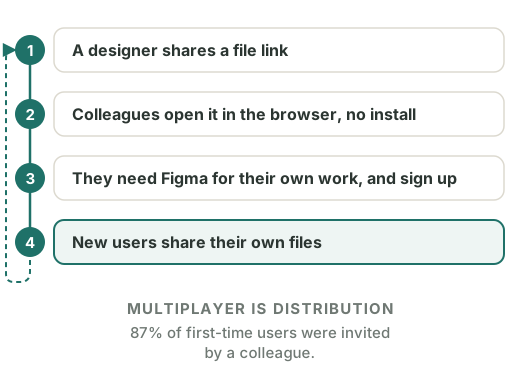
Because design is collaborative by nature, and because a Figma file was a shared space rather than a private artifact, the act of doing the work was the act of distributing the product. A designer shared a file to get feedback, and the reviewer had to open Figma to give it. Figma reported the result plainly: 87% of first-time users were invited by a colleague Figma, Five Years of Figma.
This is the same bottom-up shape as Slack's growth, but the trigger is different. Slack's loop ran on messages sent inside a team. Figma's ran on files shared across roles, which is why it did not stop at designers.
The market-expansion insight
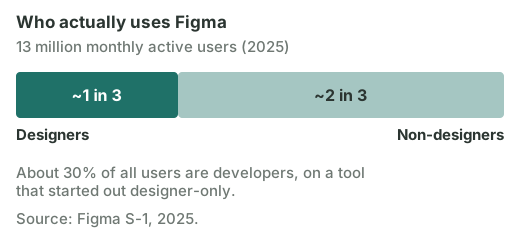
Here is the part most teardowns miss. A collaboration loop does not just acquire more of the same user. It pulls in whoever the file is shared with, and design files get shared with product managers, engineers, marketers, and executives. So Figma's user base drifted away from designers. By its 2025 IPO, about two-thirds of Figma's 13 million monthly active users were non-designers, and roughly 30% were developers Figma S-1, 2025.
That is a bigger deal than it sounds. Most tools fight to win a share of a fixed market. Figma's loop quietly expanded the market it addressed, from "people who design" to "anyone who touches a design." Figma leaned into it deliberately, adding a comment-and-view experience for non-designers and, later, a dedicated developer surface. The loop found the new users; the product made room for them.
The two bookends: a $20B offer, then an IPO
If the loop was real, the money should show it, and Figma has two unusually clear proof points.
In September 2022, Adobe agreed to acquire Figma for approximately $20 billion. At the time, Adobe disclosed that Figma had surpassed $400M in ARR, with net dollar retention greater than 150% and gross margins around 90% Adobe. Net dollar retention over 150% is the loop in one number: existing customers were expanding seats faster than any churn could take them away, which is exactly what "the file keeps pulling in more people" looks like on a P&L.
Regulators in the EU and UK challenged the deal on competition grounds, and in December 2023 the two companies terminated it. Adobe paid Figma a $1B breakup fee CNBC. Figma then went public on its own in 2025, reporting $912M in ARR up 46% year over year, about 450,000 paying customers, and net dollar retention of 132% Figma S-1, 2025.
The numbers
| Metric | Figure | As of | Source |
|---|---|---|---|
| First-time users invited by a colleague | 87% | 2021 | Figma blog |
| Monthly active users | 13M | 2025 | Figma S-1 |
| Non-designer share of users | ~two-thirds | 2025 | Figma S-1 |
| Paying customers | ~450,000 | 2025 | Figma S-1 |
| ARR | $912M (+46% YoY) | 2025 | Figma S-1 |
| Net dollar retention | 132% | 2025 | Figma S-1 |
| Adobe acquisition offer | ~$20B | Sep 2022 | Adobe |
| NDR at the Adobe deal | >150% | 2022 | Adobe |
Figures are from Figma's own blog and its S-1 (a filed, audited document). Every row maps to a verified row in our evidence ledger.
What you can't copy
Figma's loop is real and the mechanics below are learnable. But be honest about the tailwinds, because most "just make it collaborative" advice skips them:
- A genuine technical moat. Multiplayer design in the browser was a hard WebGL and performance problem that took years to get right. The collaboration loop only works if the product is actually good enough to work in, and Figma spent roughly three to four years heads-down before the public launch Wikipedia. Bolting "share a link" onto a mediocre tool does not reproduce this.
- Patient funding. Field took a Thiel Fellowship and Figma raised venture money that let the team build for years before charging. Not every team can stay pre-revenue that long.
- A naturally collaborative artifact. Design files are shared by their nature. If your product's core object is used alone, "invite a colleague" has nothing to ride on. The lesson is to find your product's inherently shared unit, not to add a share button.
Where the play has limits
Bottom-up virality gets you in the door; it does not clear every hurdle. Figma still had to build an enterprise motion to close and secure large accounts, and its most valuable customers are a small slice of the 450,000 paying base. The loop also could not protect Figma from distribution power above it: Adobe, the incumbent, tried to simply buy the loop for $20B, and it was regulators, not the product, that kept Figma independent. And a collaboration moat invites new competition on the same axis, including AI-native design tools that treat the file as a prompt. Virality wins adoption; it does not end the fight.
What you can steal
- Find your product's inherently shared object. Figma's was the file. Ask what unit of your product is naturally used with other people, and make sharing it frictionless. See the first-customers playbooks for turning that into a first channel.
- Make the first view free and instant. No install, no license to look. Every bit of friction on the first click leaks the loop.
- Design for the people the sharer invites, not just the buyer. Figma built for the non-designers who got pulled in, which expanded its market. Ask who your product's "reviewer" is and give them a real experience.
- Watch net dollar retention, not just signups. Expansion inside existing accounts is where a collaboration loop pays off. Our benchmarks hub is where retention numbers get compared.
- Study the sibling loop. Slack ran the same bottom-up shape on a different trigger. Comparing the two shows what generalises and what is product-specific.
Primary sources
- "Five Years of Figma," Figma blog. 87% of first-time users invited by a colleague. figma.com
- Figma, Inc. Form S-1, SEC, 2025. 13M MAU, ~two-thirds non-designers, ~450k paying customers, $912M ARR, 132% net dollar retention. sec.gov
- Tanay Jaipuria, "Figma S-1 Breakdown." The S-1 metrics, read carefully. tanayj.com
- "Adobe to Acquire Figma," Adobe, Sep 2022. ~$20B, >$400M ARR, >150% NDR, ~90% gross margin. news.adobe.com
- "Adobe to acquire design platform Figma for $20 billion," CNBC. Deal and later termination. cnbc.com
- "Dylan Field," Wikipedia. Founding, Thiel Fellowship, WebGL, product timeline. wikipedia.org
Every load-bearing number maps to a row in our evidence ledger with a primary-source URL, a date, and a confidence grade. The S-1 figures are from a filed, audited document; the 87% is Figma's own reporting. Where a metric could be confused (ARR versus trailing revenue) we label exactly what it counts. If we could not verify a number against a primary source, it is not here.
Frequently asked questions
- How did Figma grow?
- By making design collaborative in the browser. Because a Figma file is a shared, real-time space, designers invited teammates in to view and comment, and 87% of first-time users arrived via a colleague's invitation. That collaboration surface then expanded beyond designers: about two-thirds of Figma's 13M monthly active users are non-designers.
- What is Figma's growth loop?
- A designer shares a file link; colleagues open it in the browser with no install and collaborate; they need Figma for their own work and sign up; then they share their own files, inviting the next colleagues. Multiplayer is the distribution channel, not a feature bolted onto one.
- Why did Adobe try to buy Figma?
- Adobe agreed to acquire Figma for about $20B in September 2022, when Figma had surpassed $400M in ARR with net dollar retention over 150% and roughly 90% gross margins. Regulators in the EU and UK challenged the deal and it was terminated in December 2023, with Adobe paying a $1B breakup fee.
- How big is Figma?
- At its 2025 IPO (NYSE: FIG), Figma reported 13 million monthly active users, about 450,000 paying customers, $912M in ARR up 46% year over year, and 132% net dollar retention. About two-thirds of users are non-designers.
- Is Figma product-led growth?
- Yes. Figma is a bottom-up, product-led company: adoption spreads through shared files rather than top-down sales, and expansion shows up in net dollar retention that has run between roughly 130% and 150%.
Related teardowns
Dropbox's growth teardown: the referral program everyone misquotes
How Dropbox went from 100k to 4M users in 15 months with broken ad economics, what the two-sided referral program actually paid, and which parts of the loop you can copy.
ProjectionLab's growth teardown: the continuity gate and the vouch you can't buy
How a solo developer reached $1M ARR with no funding, no ads and no SEO team by giving away the whole engine and charging only to save your work, and which of those mechanics survive the move to B2B.
Calendly's growth teardown: the link is the ad
How Calendly turned a single scheduling link into a viral loop, bootstrapped to a $3B valuation on $550k, and reached 86% of the Fortune 500.
Last fact-checked 2026-07-05. Every figure on this page maps to a primary source in our evidence ledger.