Calendly's growth teardown: the link is the ad
How Calendly turned a single scheduling link into a viral loop, bootstrapped to a $3B valuation on $550k, and reached 86% of the Fortune 500.
Calendly is the clearest example in B2B of a product whose ordinary use is its marketing. Every time you send someone a booking link, you show them the product working, at the exact moment they need it. That single design choice, plus a founder who bootstrapped for eight years, turned a scheduling tool into a $3B company that reached most of the Fortune 500. Here is the loop, the numbers, and what actually transfers.
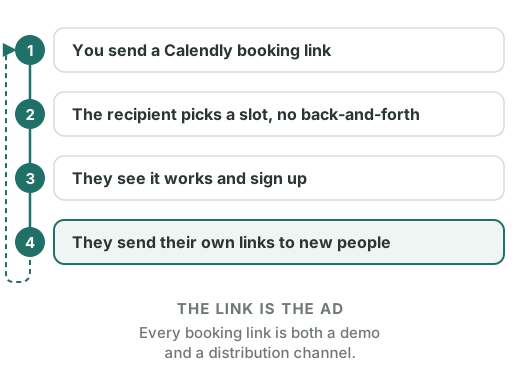
Calendly embedded distribution in its core action. Sending a booking link shows a non-user the product at the moment it solves their scheduling pain, so they sign up and send their own links. No referral program required. That loop, plus a freemium tier and eight years of bootstrapped discipline, reached 20M+ users and 86% of the Fortune 500, on just $550k raised before a $3B valuation.
Calendly by 2023
Calendly's growth, dated
How Calendly found its wedge
Scheduling a meeting used to mean an email volley: "Does Tuesday work? No? How about Thursday at 2? That is taken, what about Friday?" Calendly's wedge was to delete that volley. You share one link, the other person sees your real availability and picks a slot, and it lands on both calendars. The value is obvious in about ten seconds, which matters enormously for what comes next.
Two design choices turned that simple utility into a growth engine:
- A generous free tier. The basic product was free and immediately useful, so there was no barrier between "someone sent me a link" and "I am now using this too."
- The shared object is another person. Scheduling inherently involves at least two people. Unlike a note-taking app you use alone, Calendly's core action always points at someone else, and that someone else is a potential user.
How Calendly grew: the link is the ad
Put those together and you get a loop that runs on ordinary use. When you send a Calendly link to someone who does not use Calendly, you are not asking them to try a product. You are showing them the product solving a problem they have right now. They book a time, feel how much easier it was, and a good share of them go set up their own link. Then they send it to people who do not use Calendly yet, and the loop turns again OpenView.
The important part: there is no referral program here, no "invite a friend for a free month." The distribution is the product. That is why Calendly could grow to tens of millions of users without a large marketing budget, and why it looks less like a company that markets a product and more like a product that markets itself.
The capital-efficiency story
A loop that runs on ordinary use has a financial consequence: you do not need to buy growth. Calendly is the clearest proof of that in B2B. Founder Tope Awotona, who was born in Lagos and immigrated to the US as a teenager, started Calendly in 2013 with roughly $200k of his own savings after quitting a job selling software. He raised a single $550k seed round in 2014 and then bootstrapped for years, staying profitable from 2016 onward Forbes.
Calendly did not take large venture money until 2021, when it raised $350M at a $3B valuation TechCrunch. Read those two numbers together: about $550k of outside capital preceded a $3 billion valuation. Awotona kept a majority stake, which almost never happens in venture-backed companies. That is what a built-in distribution loop buys you: the freedom not to spend on growth in the first place.
From bottom-up to the enterprise
Bottom-up virality gets a product into companies one calendar at a time. Turning that into large contracts takes more. Calendly rode the loop into the Fortune 500 and then layered a product-led-sales motion on top to expand those footholds into paid, secured, company-wide deployments. The penetration numbers show both halves working:
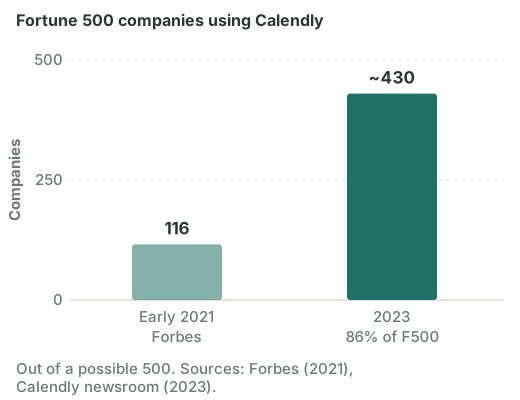
By 2023, 86% of the Fortune 500 used Calendly, enterprise adoption was up 61% year over year, and customers spending more than $50,000 a year had grown 400% year over year Calendly newsroom, 2023. The loop supplied the users; the sales motion converted the biggest ones into real money. This is the same two-step Slack ran: bottom-up to get in, a sales layer to close the whales.
The numbers
| Metric | Figure | As of | Source |
|---|---|---|---|
| Total raised before the $3B round | ~$550k | 2014 | Forbes / TechCrunch |
| Valuation | $3B | Jan 2021 | TechCrunch |
| Monthly users | ~10M | 2021 | TechCrunch |
| Users | 20M+ | 2023 | Calendly |
| Fortune 500 penetration | 116 -> 86% (~430) | 2021 -> 2023 | Forbes / Calendly |
| Enterprise adoption growth | 61% YoY | 2023 | Calendly |
| Customers spending >$50k/yr | 400% YoY | 2023 | Calendly |
| Profitable since | 2016 | ongoing | TechCrunch |
User counts are company-reported. Funding and valuation are from reporting on the rounds. Every row maps to a verified row in our evidence ledger.
What you can't copy
- A core action that already involves someone else. Calendly's loop works because scheduling inherently points at another person, who is a potential user. If your product's main action is solo, "the link is the ad" has nothing to ride on. The lesson is to find the shared moment in your product, the way Figma found the shared file, not to bolt on a share button.
- Eight years of patient discipline. Bootstrapping to profitability and staying there is unglamorous, and most investors would have pushed to raise and spend far sooner. The capital efficiency was a choice, and it is harder to copy than any tactic.
- A genuinely instant "aha." The loop only compounds if the recipient gets value in seconds. If your product needs setup or a demo to click, the shared link fizzles instead of converting.
Where the play has limits
Scheduling is a narrow wedge, and narrow wedges get bundled. Google, Microsoft, and CRM vendors like HubSpot have all added native scheduling, giving buyers a "good enough" option already inside a tool they pay for. That is the standing threat to any single-feature product: distribution power above you can hand your feature away for free. The loop also drives signups, not contracts, so Calendly still had to build real enterprise sales, security, and admin controls to convert bottom-up usage into large deals. Virality is a powerful start; it is not the whole company.
What you can steal
- Find the shared moment in your product and remove all friction from it. That moment is your loop. See the first-customers playbooks for turning it into a first channel.
- Make the recipient's first experience instant and free. No signup wall to receive value. Every second of friction on the first interaction leaks the loop.
- Let the product do the marketing before you buy any. Calendly's efficiency came from not needing paid acquisition. Exhaust the built-in loop before you open an ad account.
- Add sales after the loop, not instead of it. Bottom-up gets you in; a product-led-sales motion expands the accounts worth expanding. Our benchmarks hub compares the retention and expansion numbers that tell you when to layer it on.
Primary sources
- "Calendly Achieves 61% YoY Increase in Enterprise Growth," Calendly newsroom, Sep 2023. 86% of the Fortune 500, 20M+ users, 100k+ organizations, 400% YoY growth in $50k+ customers. calendly.com
- Amy Feldman, "Nigeria-Born Tope Awotona Poured His Life Savings Into Calendly," Forbes, Apr 2022. The ~$200k self-funding, the $550k seed, profitability since 2016, majority stake. forbes.com
- "How Atlanta's Calendly turned a scheduling nightmare into a $3B startup," TechCrunch, Jan 2021. $350M at $3B, ~10M monthly users, 116 of the Fortune 500. techcrunch.com
- "How Calendly Harnesses PLG and Virality for Growth," OpenView. The loop mechanism. openviewpartners.com
Every load-bearing number maps to a row in our evidence ledger with a primary-source URL, a date, and a confidence grade. The 2023 enterprise figures are from Calendly's own newsroom; user counts are company-reported and labelled as such. The ~$200k of founder savings and the $550k seed are different sums, and we keep them separate. If we could not verify a number, it is not here.
Frequently asked questions
- How did Calendly grow?
- Through a viral loop built into its core action. Every booking link a user sends to a non-user is both a demo and a distribution channel: the recipient books a meeting, experiences the value, and signs up to send their own links. Combined with a freemium tier, this took Calendly to 20M+ users and 86% of the Fortune 500, on very little funding.
- What is Calendly's growth loop?
- Every scheduling link sent to someone who does not yet use Calendly exposes them to the product at the moment it solves their problem. They book, see it works, sign up, and send their own links to new people. Distribution is embedded in the core action, so there is no separate referral program to run.
- How was Calendly funded, and is it profitable?
- Founder Tope Awotona bootstrapped it for about eight years, starting with roughly $200k of his own savings, plus a single $550k seed round from Atlanta Ventures in 2014. Calendly has been profitable since 2016. It did not raise large venture money until a $350M round at a $3B valuation in 2021.
- How many companies use Calendly?
- As of 2023, more than 100,000 organizations and 86% of the Fortune 500 use Calendly, with 20M+ users across 230+ countries. Enterprise adoption grew 61% year over year, and customers spending over $50k a year grew 400% year over year.
- Is Calendly product-led growth?
- Yes. Adoption spreads bottom-up through the product's core action, sharing a booking link, rather than through top-down sales. Calendly later layered a product-led-sales motion on top to expand inside large accounts.
Related teardowns
Dropbox's growth teardown: the referral program everyone misquotes
How Dropbox went from 100k to 4M users in 15 months with broken ad economics, what the two-sided referral program actually paid, and which parts of the loop you can copy.
ProjectionLab's growth teardown: the continuity gate and the vouch you can't buy
How a solo developer reached $1M ARR with no funding, no ads and no SEO team by giving away the whole engine and charging only to save your work, and which of those mechanics survive the move to B2B.
Figma's growth teardown: multiplayer as distribution
How Figma turned real-time collaboration into a growth engine: 87% of first users invited by a colleague, two-thirds of users who aren't designers, and a $20B offer on the way to IPO.
Last fact-checked 2026-07-05. Every figure on this page maps to a primary source in our evidence ledger.