Dropbox's growth teardown: the referral program everyone misquotes
How Dropbox went from 100k to 4M users in 15 months with broken ad economics, what the two-sided referral program actually paid, and which parts of the loop you can copy.
Dropbox's referral program is the most-cited growth story in SaaS, and most of the retellings get the numbers wrong — the bonus amounts, the caps, even what the 35% was a percentage of. The real story is better than the myth: a product whose ad economics were hopeless, rescued by making the product itself the incentive. Here is what actually happened, with the receipts, from Drew Houston's own 2010 accounting and Dropbox's archived pages.
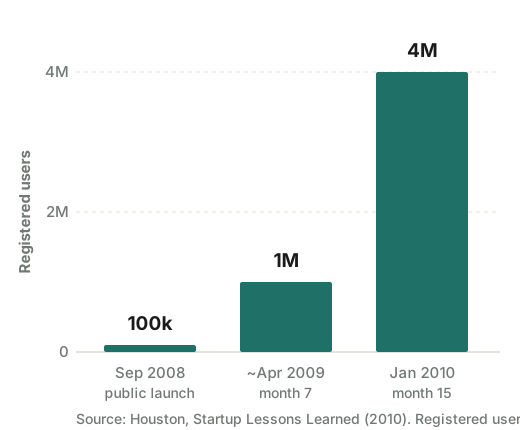
Dropbox grew from 100,000 registered users at launch (September 2008) to 4 million in 15 months (January 2010) with no working paid channel — AdWords cost $233–$388 per acquisition for a $99 product. The engine was a double-sided referral program that paid both sides in storage: it permanently lifted signups by 60%, and by April 2010 drove 35% of daily signups, with users sending 2.8 million invites a month.
Where Dropbox landed by April 2010
Dropbox's growth, dated
Every date below is sourced. Note what the sequence actually shows: two viral launch spikes before the product was even public, a failed conventional playbook, and then the loop.
Why paid marketing failed first
The referral program was not a growth hack bolted onto a working funnel. It was the replacement for a funnel that had publicly failed.
In early 2009, Dropbox did the conventional thing properly: hired an experienced search marketer, built landing pages, bought keywords, even hid the free tier behind a time-limited trial for paid-search arrivals. The result, in Houston's own slide: a cost per acquisition of $233–$388 — "for a $99 product. Fail."
Houston deck, slides 19–21His diagnosis is the part worth keeping: search harvests demand, it does not create it. Nobody woke up searching for "stop emailing myself files"; the obvious keywords were bid up by other funded startups; the long tail had no volume. If your product creates a new behaviour rather than serving an existing search, Dropbox's 2009 is the cheapest possible preview of what your ad account will do.
How Dropbox got its first users
Both pre-launch spikes came from showing the product to communities where the target user already lived — not from press or ads.
The first "MVP" was not code anyone could run: it was a 3-minute screencast posted to Hacker News in April 2007, which produced immediate, high-quality feedback while the hard engineering was still underway. The second was a private-beta launch video in March 2008, tuned for Digg's audience — it collected 12,000 diggs and moved the beta waiting list from 5,000 to 75,000 in a single day Houston deck, slides 11–13. Those are waitlist signups, not users — but they were proof of demand a venture capitalist could not argue with, gathered before launch.
The referral program, mechanically
The design has three load-bearing choices, all visible in Dropbox's own archived help pages and Houston's deck:
- Both sides get paid. The referrer and the friend each earn bonus storage. Nobody is spamming friends for one-sided gain — the invite reads as a gift, which is why users sent 2.8 million of them in a single month.
- The reward is the product. Bonus storage costs Dropbox marginal cents, but for the user it is exactly the thing they ran out of. The people most motivated to refer are the heaviest users — the ones closest to their 2 GB cap.
- The bonus lands only after install. Space is credited when the friend registers and installs — so every paid reward corresponds to a user who reached the product's first-value moment, not a dead signup Dropbox help, Jan 2010 (archived).
The version you have read — "500 MB for both sides, up to 16 GB" — blends eras and tiers. Dropbox's own help page in August 2010 states: free (Basic) accounts could earn up to 8 GB of bonus space, for 10 GB total; the 16 GB cap belonged to Pro subscribers Dropbox help, Aug 2010 (archived). The per-referral amount in the growth era is consistently reported as 250 MB for free accounts (500 MB for Pro), but the archived pages we could find state only the caps — so treat the 250 MB figure as well-supported secondary, not gospel. The 500 MB free-tier bonus dates from the 2012 doubling, two years after the growth this teardown covers.
Sean Ellis — later the coiner of "growth hacking", then running Dropbox's early marketing — layered measurement on top: surveys, split tests, and landing-page and signup-flow optimisation. Houston's slide credits the program design's inspiration to PayPal's $5 signup bonus, converted from cash into storage.
The compounding loop
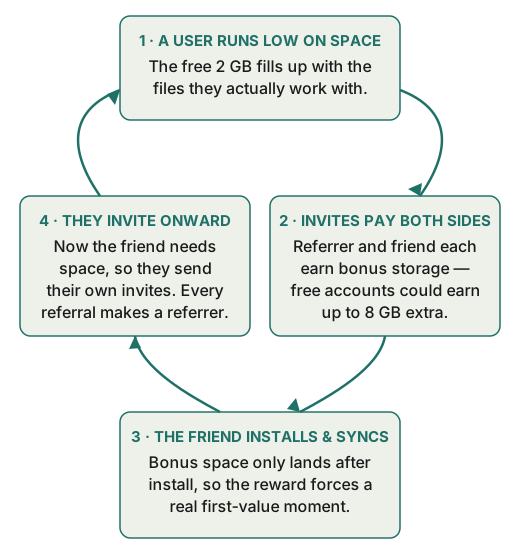
What makes this a loop rather than a promotion is that the reward regenerates the trigger. The invited friend starts with 2 GB, fills it with real files (the install requirement guarantees they actually use it), runs out of space, and faces the same choice their referrer did: pay, or invite. Referrals were not the only viral surface either — shared folders put Dropbox in front of non-users as a side effect of normal use, and Houston's accounting splits the credit: 35% of daily signups from referrals, 20% from shared folders and other viral features. More than half of daily growth, from mechanics that cost storage rather than dollars.
The numbers that followed
The 2010 story is registered users; the honest bookend is the audited 2018 S-1. Dropbox reached 500 million registered users, of whom 11 million paid — 2.2% — producing $1,106.8 million of FY2017 revenue at $111.91 average revenue per paying user Dropbox S-1, 2018. Two things are true at once: the referral loop built one of the largest user bases in software history, and only one in fifty of those users ever paid. That ratio is normal for freemium — see our freemium conversion benchmarks — but it means the loop's real output was a distribution asset that took a decade and a business-tier pivot (about 300,000 paying teams by the S-1) to monetise properly.
What you can't copy
- The product is the loop. File sync is inherently multi-person — shared folders recruit non-users during normal use. If your product is single-player, a storage-style referral program buys you a promotion, not a compounding loop.
- A reward with near-zero marginal cost. Dropbox paid referrers in server gigabytes. If your unit economics make the equivalent gift expensive (seats, credits, service time), the same design has a real cost line.
- A recurring trigger. Storage need comes back every few months and re-arms the loop. A one-time incentive on a product without a recurring scarcity behaves like a coupon.
- 2008's distribution environment. Digg, a quieter Hacker News, and empty referral inboxes. The channels that made the launch videos work are either gone or saturated; the method (demo where your users already gather) survives, the specific spike does not.
Where the play has limits
Referral-led freemium built reach, not revenue. The S-1's 2.2% paying ratio is the structural cost of giving the product away well; storage itself became a commodity that Google and Microsoft bundled at prices Dropbox could not sustain a moat on, and the company's durable revenue came from the later business-team motion, not the consumer loop. The loop also measures one thing and not another: 35% of daily signups says nothing about activation or retention of those signups — Dropbox's install-gated bonus partially closed that gap, but a referral program that pays on signup alone will fill your database with dead accounts. Benchmark what a referred signup is worth against our activation-rate evidence before you copy the split.
What you can steal
- Pay both sides, in product. A one-sided bounty reads as spam; a two-sided gift gets sent 2.8 million times a month. Ask what your storage-equivalent is — the thing heavy users run out of. Start from the PLG vs sales-led fit question if you are not sure your motion supports it.
- Gate the reward on activation, not signup. Dropbox credited space only after install. Pick your product's first-value action and pay there — it aligns the program with real growth and kills fake-referral fraud in the same move.
- Run the CPA test before scaling any paid channel. One quarter of honest paid-search spend told Dropbox the channel could never work. Compute your ceiling CPA against price first; if the obvious keywords already exceed it, you have your answer for a fraction of the usual tuition.
- Demo where your users already are. A screencast on Hacker News and a Digg-tuned video produced both pre-launch spikes for the cost of a video. The equivalent today is showing the real product in the community your buyer actually reads — see how real B2B companies got their first 10.
- Measure the split. Houston could say "35% referrals, 20% shared folders" because attribution was built in. If you cannot decompose your daily signups by mechanism, you cannot tune the loop.
Primary sources
- Drew Houston, "Startup Lessons Learned" (conference deck, 34 slides), April 2010. The 100k→4M timeline, 35%/20% signup split, +60% permanent lift, 2.8M invites, $233–388 CPA, Digg waitlist jump, 1M-at-month-7, 15–20% MoM. slideshare.net
- Dropbox, "How do I earn bonus space for referring friends to Dropbox?", archived help page. Jan 2010 snapshot (two-sided mechanic, install requirement) and Aug 2010 snapshot (8 GB free-tier cap, 16 GB Pro cap). web.archive.org
- Dropbox, Inc., Form S-1, SEC, February 2018. 500M registered users, 11M paying, $1,106.8M FY2017 revenue, ARPU $111.91. sec.gov
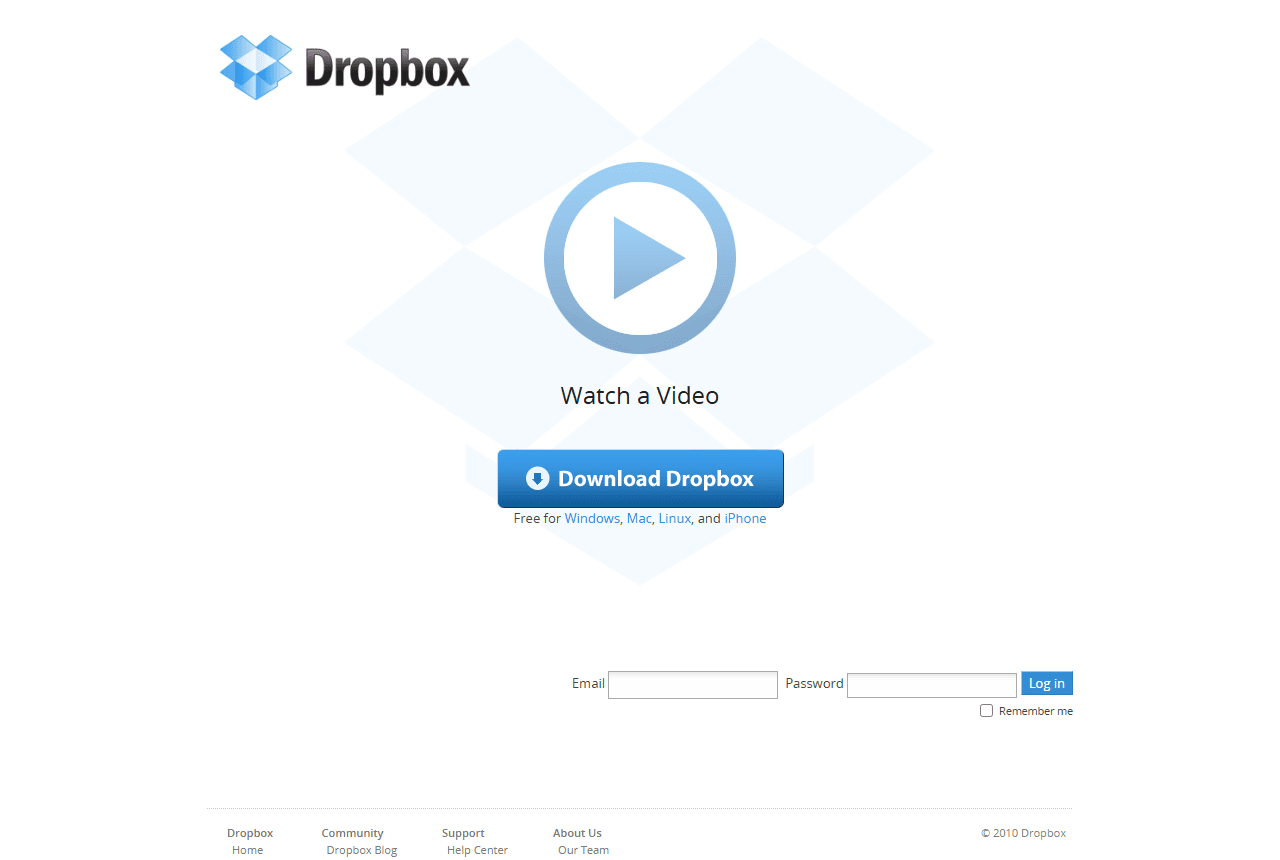
- Dropbox homepage, January 2010, Internet Archive. The video-and-download front door. web.archive.org
- "Dropbox" and "Drew Houston", Wikipedia. Founding, Y Combinator, Nasdaq listing dates. wikipedia.org
Every load-bearing number above maps to a row in our evidence ledger with a primary-source URL, a date, and a confidence grade. The growth-era figures are Drew Houston's own 2010 deck — self-reported registered users, labelled as such, never conflated with active or paying users; the 2018 figures are from the audited S-1. Where the record is weaker than the legend — the 250 MB per-referral amount — we grade it Med and say so rather than repeat the myth. If we could not verify a figure against a primary source, it is not on this page.
Frequently asked questions
- How did Dropbox grow so fast?
- Not through advertising — Dropbox's paid-search cost per acquisition ran $233 to $388 for a $99 product, so they killed it. Growth came from word of mouth and viral mechanics: at the April 2010 measurement, 35% of daily signups came from the two-sided referral program and another 20% from shared folders and other viral features, sustaining 15–20%+ month-over-month growth from launch to 4 million registered users.
- How did Dropbox's referral program work?
- It was double-sided: both the referrer and the invited friend earned bonus storage, and the bonus only landed once the friend actually installed Dropbox. Per Dropbox's own help pages in 2010, free accounts could earn up to 8 GB of bonus space (10 GB total) and Pro accounts up to 16 GB extra. Drew Houston said the program permanently increased signups by 60%.
- How much of Dropbox's growth came from referrals?
- Houston's April 2010 numbers: the referral program drove 35% of daily signups, shared folders and other viral features another 20%, and users had sent 2.8 million direct referral invites in the trailing 30 days. The program's launch permanently lifted signups by 60%.
- Why didn't paid advertising work for Dropbox?
- Because search harvests demand and nobody was searching for the problem. Houston's own diagnosis: people didn't wake up wishing they could stop emailing themselves files, obvious keywords were bid up by other venture-backed startups, and the long tail had no volume. The result was a $233–$388 cost per acquisition against a $99 product.
- Did Dropbox really give 500 MB per referral up to 16 GB?
- Not in its growth era. Dropbox's own archived help page from August 2010 says free accounts could earn up to 8 GB of bonus space; the 16 GB cap applied to Pro subscribers. The widely-copied '500 MB both ways, 16 GB cap' version blends the post-2012 doubled bonus with the Pro-tier cap. In the 100k-to-4M period, the free-tier per-referral bonus was reported as 250 MB, with the 8 GB cap on Dropbox's own page.
Related teardowns
ProjectionLab's growth teardown: the continuity gate and the vouch you can't buy
How a solo developer reached $1M ARR with no funding, no ads and no SEO team by giving away the whole engine and charging only to save your work, and which of those mechanics survive the move to B2B.
Calendly's growth teardown: the link is the ad
How Calendly turned a single scheduling link into a viral loop, bootstrapped to a $3B valuation on $550k, and reached 86% of the Fortune 500.
Figma's growth teardown: multiplayer as distribution
How Figma turned real-time collaboration into a growth engine: 87% of first users invited by a colleague, two-thirds of users who aren't designers, and a $20B offer on the way to IPO.
Last fact-checked 2026-08-08. Every figure on this page maps to a primary source in our evidence ledger.