Free trial vs freemium vs reverse trial: which converts?
Free trials convert highest per signup (opt-in ~18.5%, opt-out ~48.8%), freemium lowest (~2-5%) but at scale, and reverse trial is the hybrid. How to pick, with sourced numbers.
Per signup, a free trial converts highest (opt-in around 18.5% median, opt-out around 48.8%), freemium converts lowest (about 2 to 5%) but scales to a far bigger free base, and a reverse trial is the hybrid: full premium access that downgrades to a free tier instead of locking users out. Pick by time-to-value, price, and how much top-of-funnel traffic you have. There is no single best model, only the best fit for your funnel.
"Free trial vs freemium" is the pricing question every B2B founder hits, and "reverse trial" is the newer option that tries to end the debate by doing both. The three are not really rivals; they are three different bets on the same tradeoff between conversion rate and reach. Here is how each works, what each actually converts at, and how to choose.
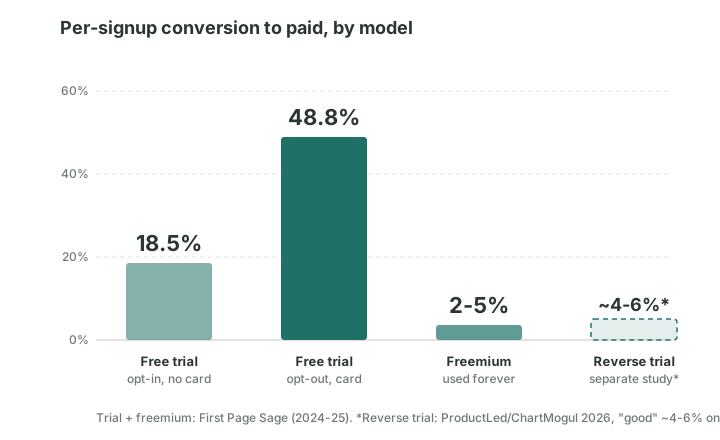
The three models at a glance
| Model | How it works | Per-signup conversion | Best when |
|---|---|---|---|
| Free trial | Full or near-full access for a fixed window, then it expires | Opt-in ~18.5%, opt-out ~48.8% | Users reach value fast and you have enough traffic |
| Freemium | A free tier used indefinitely; pay to unlock more | ~2-5% | You can monetize a small share of a very large base |
| Reverse trial | Full premium access for a window, then downgrades to a free tier | ~4-6% "good" (separate study) | You want trial-style exposure plus a permanent free tier |
Trial and freemium figures are aggregated analyst benchmarks (First Page Sage); the reverse-trial figure is from a separate 2026 study (ProductLed/ChartMogul) on a different basis, so it is not directly comparable to the others. All graded Medium in our evidence ledger; ranges, not targets.
Free trial: highest conversion, but it needs traffic
A free trial expires, which forces a decision: pay or lose access. That pressure is why trials convert in double digits. The single biggest lever is whether you require a credit card. Opt-in trials (no card) convert at a median around 18.5% First Page Sage, while opt-out trials (card up front) convert around 48.8% and yield roughly 3x more paying customers from the same traffic First Page Sage. The catch is that the card requirement sharply cuts how many people start at all, so a trial only wins outright if enough people reach value inside the window. If they cannot, you are just expiring people before they see the point. Full detail and the by-industry ranges are on the free trial conversion rate page.
Freemium: lowest conversion, highest reach
A freemium free tier never expires, so most users happily stay free forever. That is not a failure of the model; it is the model. Freemium converts around 2 to 5% First Page Sage, far below a trial, because you are monetizing a small share of a very large base rather than a large share of a small one. So a 3% freemium rate on a million users can dwarf a 20% trial rate on ten thousand. Judge freemium on total paying customers and the health of the free-to-paid pipeline, not on the percentage. The full ranges are on the freemium conversion rate page.
Reverse trial: the hybrid, and an honest caveat
A reverse trial gives new users full premium access for a set window, then downgrades them to a free or freemium tier when it ends, rather than cutting them off Appcues. The idea is to get the best of both: users experience your most valuable features from day one (like a trial), and if they do not pay, they land softly on a free tier and keep the habit (like freemium), so you can convert them later. Slack, Notion, and many others effectively run a version of this.
Here is the honest state of the data. Most reverse-trial conversion numbers that circulate are not tied to a dated, primary source, so we ignore them. The one benchmark we could actually stand behind is a 2026 study of 200 B2B products by ProductLed and ChartMogul, which puts reverse-trial conversion at roughly 4 to 6% for a "good" result and 8 to 12% for a "great" one ProductLed / ChartMogul, 2026. Two caveats keep that honest. It is a single study on a self-selected sample, not settled canon. And it uses a different method than the First Page Sage trial and freemium figures above (it measures free-to-paid across all signups within six months), so it is not directly comparable to them, which is why the chart shows it as a separate, dashed bar. Treat reverse trial as a promising model with thinner public data than trial or freemium, and measure it against your own baseline.
How to choose
Three questions settle it more often than any benchmark:
- How fast is your time-to-value? If a new user can reach a real "aha" in minutes, a free trial has something to ride on. If value takes weeks to appear, a trial window will expire before it lands, and freemium (or a reverse trial) buys you time.
- How much top-of-funnel volume do you have? Freemium and reverse trials only pay off at scale, because you monetize a small slice of a big base. If your traffic is thin, a higher-converting trial (especially opt-out) usually produces more customers than a low-converting free tier.
- How valuable are the gated features? If your best features are compelling and clearly worth paying for, exposing them early (trial or reverse trial) tends to beat hiding them behind a freemium wall where users never feel what they are missing.
Whichever you pick, the number that actually moves conversion is usually activation, not the pricing model: getting users to real value inside the window. The growth teardowns show how companies like Slack engineered that, and product-qualified leads are how you spot the free or trial users worth a human nudge.
Related
Compare the underlying numbers on free trial conversion rates and freemium conversion rates. This is the free-to-paid choice; for how you meter the bill once they pay, see usage-based vs per-seat pricing. See PLG vs sales-led for the wider go-to-market choice, and read the growth teardowns for these models in practice.
Frequently asked questions
- Which converts better, free trial or freemium?
- Per signup, a free trial converts far higher: opt-in trials at a median around 18.5%, opt-out (card required) around 48.8%, versus about 2 to 5% for freemium. But freemium acquires many more users, so the total number of paying customers depends on volume. A free trial optimizes conversion; freemium optimizes reach.
- What is a reverse trial?
- A reverse trial is a time-boxed trial that gives new users full premium access, then downgrades them to a free or freemium tier when the trial ends, instead of locking them out. It aims to combine a trial's forced value experience with freemium's soft landing, so users keep a habit even if they do not pay right away.
- Is a reverse trial better than freemium or a free trial?
- In theory it captures the strengths of both: full-feature exposure like a trial, plus a permanent free tier like freemium. One 2026 study of 200 B2B products (ProductLed and ChartMogul) puts reverse-trial conversion around 4 to 6% for a good result and 8 to 12% for a great one, but that is a single dated data point on a different basis than most trial benchmarks, not settled proof it wins. Test it against your own trial or freemium baseline rather than assuming.
- How do I choose between free trial, freemium, and reverse trial?
- Choose by three things: time to value, price, and top-of-funnel volume. If a user can reach real value fast and you have enough traffic, a free trial converts best. If your free tier is naturally viral and you can monetize a small share of a huge base, freemium fits. If your best features are worth gating but you still want a broad free top-of-funnel, a reverse trial is worth testing.
- Should I require a credit card for a free trial?
- It is a tradeoff. Opt-out trials (card required) convert around 48.8% versus about 18.5% for opt-in, and produce roughly 3x more paying customers from the same traffic, but far fewer people start the trial. Whether it nets out ahead depends on how much top-of-funnel volume you have, so test it.
Related guides
ABM vs demand generation: which should you run?
Demand generation casts a wide net and qualifies leads down a funnel. ABM starts with a named account list and works it in reverse. What the actual dated studies say (not the recycled 87% stat), and why most B2B teams now run both.
What is a reverse trial?
A reverse trial gives new users full premium access for a set window, then downgrades them to a free tier instead of locking them out. How it works, who runs it, what it converts at, and when to use it.
What is usage-based pricing?
Usage-based pricing charges for what customers consume — API calls, gigabytes, events, credits — so the bill scales with usage, not headcount. How it works, why it wins on expansion (~120% vs ~110% NRR), and its real tradeoff.
Last fact-checked 2026-07-08. Every figure on this page maps to a primary source in our evidence ledger.