HubSpot Website Grader teardown: a free tool as a growth engine
How one free tool graded 4M+ websites, earned tens of thousands of backlinks, and fed HubSpot a stream of pre-qualified leads. The linkable-asset playbook, sourced.
Slack, Figma, and Calendly grew because using the product spread the product. HubSpot's Website Grader is the other archetype: growth that comes from giving something valuable away for free, outside the product, to earn links and leads. It is the most-cited example of the "free tool as a growth engine" play, and the numbers behind it are real. Here is how it worked and what actually transfers.
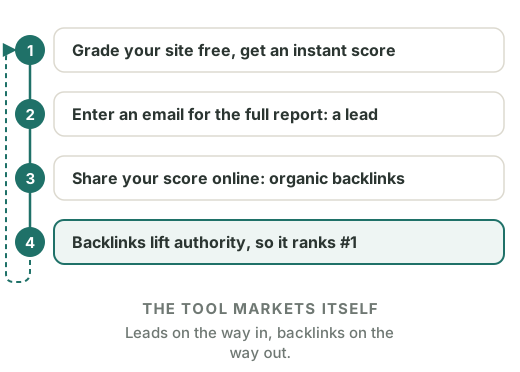
HubSpot gave away a free tool that graded your website 0 to 100. Getting the full report cost an email, so every use produced a pre-qualified lead. And because people shared their scores, the tool earned roughly 40,000 backlinks, which lifted HubSpot's entire domain authority. It graded 4M+ sites, still ranks #1 for "website grader," and became the template for the whole linkable-asset playbook.
Website Grader, 2006 to 2011
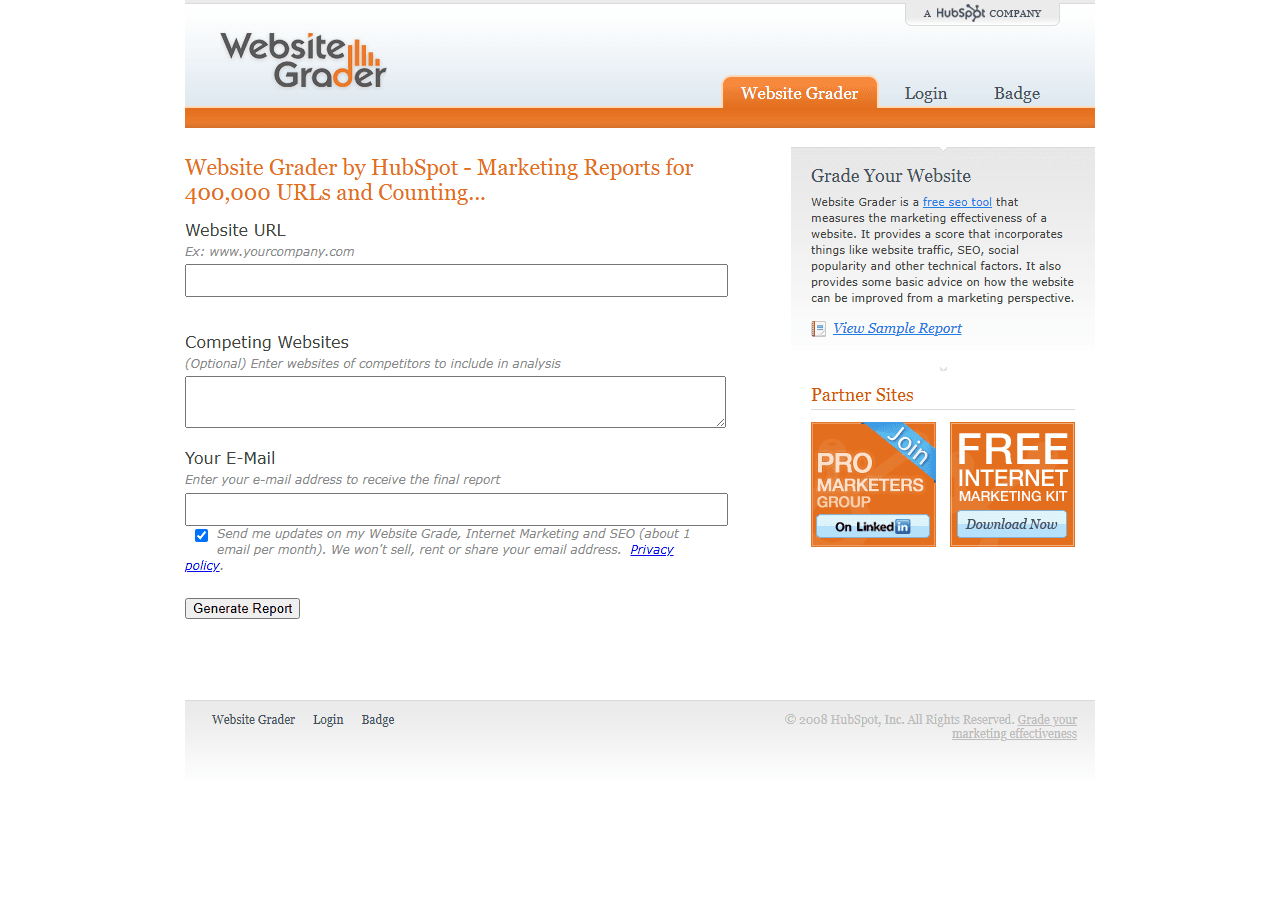
HubSpot Website Grader, dated
The wedge: give away a genuinely useful answer
Most free "tools" are thin lead-capture forms wearing a costume. Website Grader was not. It did real work: you gave it a URL and it returned a specific, personalized score with concrete things to fix. That distinction is the whole game. A tool that gives a real answer gets used, shared, and linked. A tool that just gates a generic PDF behind an email gets ignored.
And the audience self-selected perfectly. The only people who grade their website are people who care about their website, which is exactly who HubSpot wanted to sell marketing software to. The tool did qualification for free: it did not just generate leads, it generated the right leads.
The flywheel: leads on the way in, backlinks on the way out
Here is the part worth studying. Website Grader produced two different kinds of value from the same action, and they operated on different timescales.
The immediate harvest was leads. To see the full report you entered an email, which handed HubSpot a stream of pre-qualified prospects. Several accounts put this in the millions of leads, with multiple millions generated within the first year HubSpot / analyses.
The compounding harvest was backlinks. People shared their scores on blogs and forums, and because the tool was genuinely useful, others linked to it as a utility. That earned roughly 40,000 organic backlinks Outgrow analysis. No outreach campaign produces links like that. The tool produced them as a byproduct of being good.
Why the backlinks mattered more than the leads
Leads are consumed once. A backlink keeps working. Those 40,000 links did not just point at the grader page, they lifted the authority of HubSpot's entire domain. That authority cascaded: HubSpot's blog posts, landing pages, and other tools all ranked better because the domain they lived on was more trusted. In effect, one free tool bought a permanent tailwind for everything else HubSpot published. The grader graded 4 million sites HubSpot, 2011, and it still ranks #1 for its keywords years later, long after the leads were closed or lost.
The numbers
| Metric | Figure | As of | Source |
|---|---|---|---|
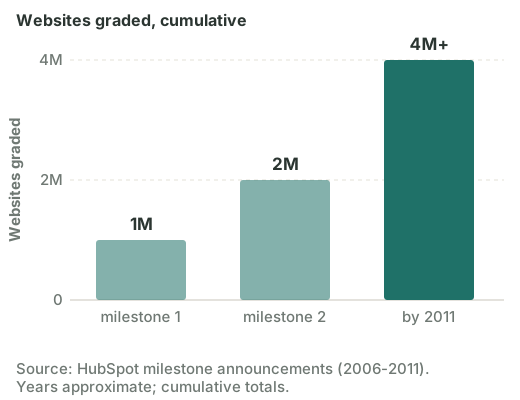
| Websites graded | 4M+ | 2006-2011 | HubSpot |
| Milestones along the way | 1M, then 2M | ~2009-2010 | HubSpot blog |
| Organic backlinks earned | ~40,000 | ~2011 | Outgrow / analyses |
| Leads captured | millions | 2006-2011 | HubSpot / analyses |
| Still ranks #1 for "website grader" | yes | today | analysis |
The graded-sites and milestone figures are HubSpot's own. The ~40,000 backlinks is a widely repeated analyst figure (graded Medium in our ledger, not a HubSpot primary). Every row maps to a ledger row with its confidence.
What you can't copy
- A built-in promotion channel. HubSpot already had a popular blog to launch the tool into. A free tool nobody sees earns nothing. The tool did not distribute itself; the blog distributed it.
- Being early. In 2007, a free website grader was novel and the "website grader" keyword was wide open. Today the tactic is saturated, so a me-too grader competes with dozens and earns few links. Timing was part of the moat.
- Real engineering behind the answer. The grade had to be genuinely useful, which took real work. A thin score dressed up as a tool would not have earned 40,000 links.
Where the play has limits
The free-tool play is now a crowded tactic, and a grader only works if its output is genuinely useful and shareable; a vanity score fools no one. The leads it generates are top-of-funnel, so they need real nurturing to become revenue, and a tool that qualifies badly floods your pipeline with people who will never buy. And unlike the product-led loops in Slack, Figma, and Calendly, a linkable asset sits outside the product, so it drives awareness and leads but does not deepen usage on its own. It is a front door, not the house.
What you can steal
- Build a tool that gives a real, personalized answer, not a gated PDF. The usefulness is what earns the links. See the first-customers playbooks for where a linkable asset fits in an early channel mix.
- Let the audience qualify itself. Pick a tool whose users are, by definition, your buyers. The grader worked because only your prospects use it.
- Gate the full report, not the value. Give a real result for free; ask for an email to go deeper. Gating everything kills the sharing that earns the links.
- Optimize for the backlinks, not just the leads. The compounding win is domain authority. Make the output worth linking to, and rank the tool for its own keyword. Our benchmarks hub is the kind of linkable, citable asset this play produces.
Primary sources
- "HubSpot Launches Comprehensive Free Marketing Grader Tool After Grading 4 Million Websites," PRNewswire, 2011. 4M+ sites graded; the successor to Website Grader. prnewswire.com
- "Website Grader Analyzes Over 2 Million Sites," HubSpot blog. A milestone announcement. hubspot.com
- "HubSpot's Website Grader: A Lead Generation Success Story," Outgrow. The ~40,000 backlinks and the lead-gen mechanism. outgrow.co
- "How HubSpot's Website Grader (and AEO Grader) Won at SEO," Startup Spells. The linkable-asset and domain-authority analysis. startupspells.com
Every load-bearing number maps to a row in our evidence ledger with a primary-source URL, a date, and a confidence grade. The graded-sites and milestone figures are HubSpot's own; the ~40,000 backlinks is a widely repeated analyst figure that we grade Medium, not a HubSpot primary. Where a date is approximate (the milestone years) we say so. If we could not verify a number, it is not here.
Frequently asked questions
- What was HubSpot's Website Grader?
- A free tool built around 2007 by HubSpot co-founder Dharmesh Shah. You entered a URL and got an instant 0-to-100 grade of your website, and an email address unlocked the full report. Between 2006 and 2011 it graded more than 4 million websites and became the canonical example of a free tool used as a growth engine.
- How did Website Grader help HubSpot grow?
- Two ways at once. It captured millions of pre-qualified leads, because anyone grading their site was exactly HubSpot's target customer, and it earned roughly 40,000 backlinks as people shared their scores, which lifted HubSpot's whole domain authority and search rankings, not just the tool's page.
- What is a linkable asset?
- A genuinely useful free resource, a tool, dataset, or calculator, that people link to as a utility rather than as marketing. Website Grader is the canonical example: bloggers, educators, and consultants referenced it because it was useful, earning tens of thousands of backlinks no outreach campaign could match.
- Is a free grader tool still a good growth tactic?
- The mechanism still works, but the tactic is saturated: nearly every SaaS now has a grader, so a me-too version earns little. It only pays off if the tool gives genuinely useful, shareable output and you have a way to get it in front of people, the way HubSpot had its blog.
- How many websites did Website Grader grade?
- More than 4 million between 2006 and 2011, per HubSpot, crossing 1 million and then 2 million along the way. It was replaced by Marketing Grader in 2011.
Related teardowns
Dropbox's growth teardown: the referral program everyone misquotes
How Dropbox went from 100k to 4M users in 15 months with broken ad economics, what the two-sided referral program actually paid, and which parts of the loop you can copy.
ProjectionLab's growth teardown: the continuity gate and the vouch you can't buy
How a solo developer reached $1M ARR with no funding, no ads and no SEO team by giving away the whole engine and charging only to save your work, and which of those mechanics survive the move to B2B.
Calendly's growth teardown: the link is the ad
How Calendly turned a single scheduling link into a viral loop, bootstrapped to a $3B valuation on $550k, and reached 86% of the Fortune 500.
Last fact-checked 2026-07-05. Every figure on this page maps to a primary source in our evidence ledger.