What is a PQL (product-qualified lead)?
A product-qualified lead is a user who shows buying intent through real product usage, not marketing engagement. What a PQL is, how it differs from an MQL, and why it converts far better.
A product-qualified lead (PQL) is a user who has shown buying intent through real product usage, not marketing engagement. Instead of qualifying a lead by whitepaper downloads or email opens, you qualify them by what they did in the product: reached a core feature, invited teammates, imported real data. Because usage predicts buying far better than engagement, PQLs convert much higher.
If your product has a free trial or a free tier, the most valuable thing you can know is which users are actually ready to buy. That is what a PQL tells you. It is the core idea that makes product-led sales work.
MQL, PQL, and SQL
Three terms get tangled, so here is the plain version:
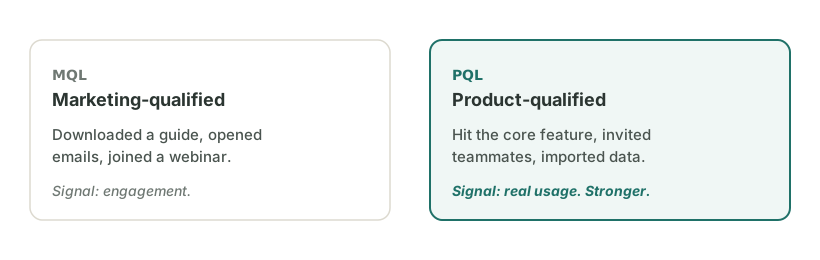
- MQL (marketing-qualified lead): qualified by marketing engagement. They downloaded something, came to a webinar, opened your emails. Marketing thinks they might buy.
- PQL (product-qualified lead): qualified by real product usage. They used the core feature, invited their team, imported real data. The product shows they might buy.
- SQL (sales-qualified lead): a lead sales has vetted and accepted as worth pursuing.
The shift from MQL to PQL is the shift from "who engaged with our marketing" to "who got value from our product," and the second question has a much better answer.
Why PQLs convert better
Using a product is a far stronger predictor of buying it than reading about it. That is why free trials scored with PQLs convert to paid about 2.8x higher than trials that are not Gainsight. A PQL has already felt the value, so a timely sales touch or upgrade prompt reaches someone who is close to ready, rather than someone who once downloaded a PDF. The full numbers are in our PQL conversion rate benchmarks.
How to define your PQL
A PQL is simply the set of behaviors that predict a user will stick and pay. The canonical example comes from Slack: teams that exchanged 2,000 messages had "really tried it," and about 93% kept using it, so 2,000 messages became the activation threshold. Your PQL is your version of that number:
- Look at users who converted and users who churned.
- Find the behavior or usage level that separates them.
- Set that as your PQL threshold, and route users who cross it to a human or a well-timed prompt.
Related
See PQL conversion rate benchmarks for the numbers, and PLG vs sales-led for where PQLs fit in the bigger picture. The growth teardowns show activation metrics (the raw material of a PQL) in the wild.
Source
- "Benchmark: Product Qualified Lead (PQL) Conversion Rates," Gainsight. gainsight.com
Frequently asked questions
- What is a PQL?
- A product-qualified lead (PQL) is a user who has demonstrated buying intent through real product usage, such as reaching a core feature, inviting teammates, or importing real data. Unlike a lead qualified by marketing engagement, a PQL is qualified by what the person actually did in the product, which makes it a much stronger signal of intent to buy.
- What is the difference between a PQL and an MQL?
- An MQL (marketing-qualified lead) is qualified by marketing engagement, like downloading a whitepaper or opening emails. A PQL (product-qualified lead) is qualified by real product usage. The PQL signal is stronger because using the product predicts buying it far better than reading about it does.
- Why do PQLs convert better?
- Because usage is a stronger buying signal than engagement. Free trials that use PQL scoring convert to paid about 2.8x higher than trials that don't. A PQL has already experienced value in the product, so a well-timed sales touch or upgrade prompt lands on someone who is closer to ready.
- How do I define a PQL for my product?
- Find the in-product behaviors that predict a user will stick and pay, then set a threshold. Slack's classic example was teams that sent 2,000 messages, past which about 93% kept using it. Your PQL is your equivalent: the action or usage level that separates users who convert from users who churn.
Related guides
ABM vs demand generation: which should you run?
Demand generation casts a wide net and qualifies leads down a funnel. ABM starts with a named account list and works it in reverse. What the actual dated studies say (not the recycled 87% stat), and why most B2B teams now run both.
What is a reverse trial?
A reverse trial gives new users full premium access for a set window, then downgrades them to a free tier instead of locking them out. How it works, who runs it, what it converts at, and when to use it.
What is usage-based pricing?
Usage-based pricing charges for what customers consume — API calls, gigabytes, events, credits — so the bill scales with usage, not headcount. How it works, why it wins on expansion (~120% vs ~110% NRR), and its real tradeoff.
Last fact-checked 2026-07-05. Every figure on this page maps to a primary source in our evidence ledger.