Slack's growth teardown: bottom-up adoption and the 2,000-message rule
How Slack went from an invite-only preview to 10M+ daily users, the activation number that shaped the product, and what you can (and can't) copy.
Slack is the case study everyone cites and almost nobody sources correctly. The popular version ("it went viral") skips the parts worth stealing: a deliberate bottom-up motion, a launch that manufactured scarcity, a single activation number the whole product was tuned around, and a pricing model that only charged for value delivered. Here is what actually happened, with the receipts, plus an honest look at what you cannot copy.
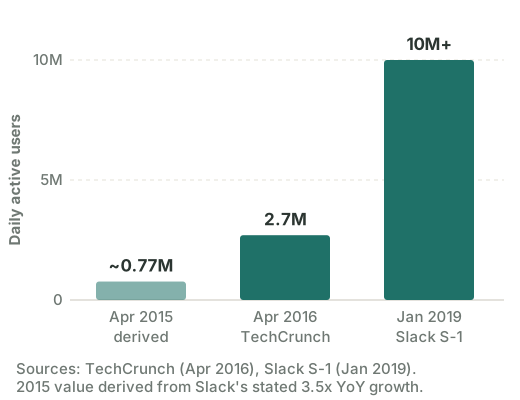
Slack grew by selling to individual teams instead of IT, then engineering onboarding around one number: 2,000 messages sent, the point where about 93% of teams stick. Teams that stuck invited more teammates, which drove more messages, which pulled in the next team. That loop took Slack from ~0.77M daily users (2015) to 2.7M (2016) to 10M+ (2019), and shows up as 143% net dollar retention in its IPO filing.
Where Slack landed by April 2016
Slack's growth, dated
Every date below is sourced. The story is not "overnight"; it is a pivot, a deliberate preview, and then a compounding loop that ran for six years.
How Slack found its wedge
Work chat in 2013 meant email threads plus whatever ad hoc tools each team had bolted on. The pain was not "we have no way to talk," it was "our conversation, files, and tools are scattered across ten places." Slack's bet was that a single, searchable, integrated home for a team's conversation would be sticky in a way email never was.
That framing set the growth motion. Most B2B software of the era was sold top-down: a vendor convinced an executive, the executive mandated a rollout, and adoption was enforced from above. Slack ran the opposite play. One team inside a company adopted it because it made their week better, then pulled in the people they worked with. Adoption spread sideways long before anyone signed a contract.
Two specific mechanics made that motion work, and they are the copyable part:
- Pricing that only charged for value delivered. Slack's Fair Billing policy bills you only for active members. A member counts as active only if they took an action within a 28-day window, and inactive members are credited back on a prorated basis Slack, Fair Billing Policy. So the company's incentive (more active users) and the customer's incentive (only pay for people actually using it) pointed the same way. That is rare, and it removed the usual friction of "we are paying for seats nobody touches."
- Integrations as a moat. Connecting the tools a team already used (and making the conversation searchable across them) is what turned Slack from "another chat app" into the place work happened. The more a team wired in, the harder it was to leave.
How Slack got its first users
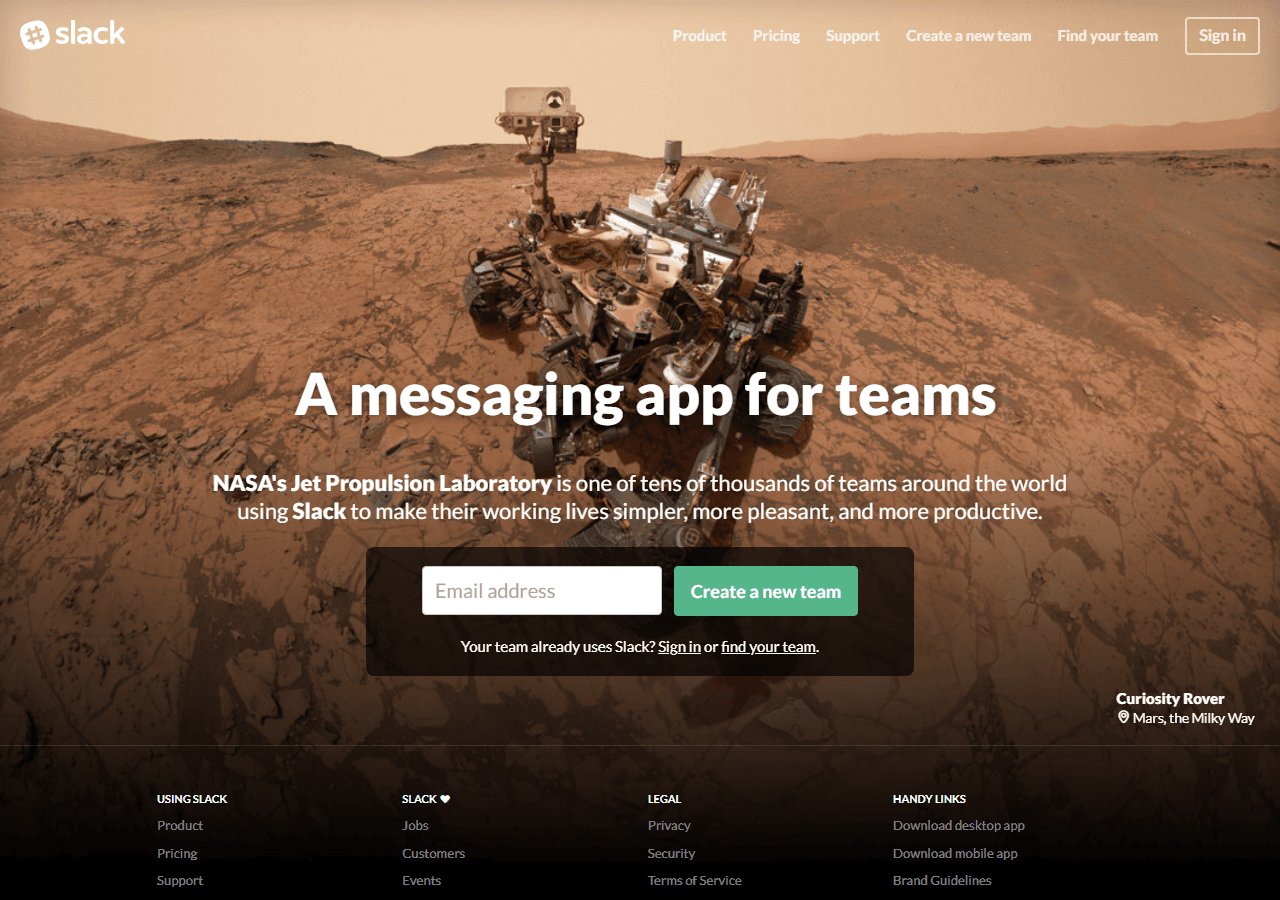
Slack did not open the doors and hope. It launched an invite-only preview in August 2013, and the scarcity did real work. On the first day, 8,000 people requested an invitation. Within two weeks, that was 15,000 First Round Review.
You will often see this stated as "Slack grew from 16k users to 2.7M." That is wrong on the metric. The early figure was roughly 15,000 invitation requests, not daily active users. Requesting an invite is not the same as using a product every day. We keep the two separate, because the whole point of this site is that the number has to mean what it says.
The activation metric: 2,000 messages
Here is the insight worth the whole teardown. Slack found that a team's future was decided by one behaviour: how many messages it sent. Co-founder Stewart Butterfield put it plainly: "Any team that has exchanged 2,000 messages in its history has tried Slack, really tried it" First Round Review. Past that threshold, about 93% of teams kept using it First Round Review (Slack data).
For a 50-person team, 2,000 messages is roughly ten hours of conversation. For a team of ten, it is about a week. So the entire onboarding job became one thing: get a team to that number as fast as possible. This is the part most teardowns skip. Slack did not just measure the metric, it engineered toward it. Slackbot walked new users through inviting teammates, creating channels, and connecting existing tools. None of those are busywork. Every one of them raises message volume and pulls the team toward the point where it sticks. Onboarding was activation, not a feature tour.
The compounding loop
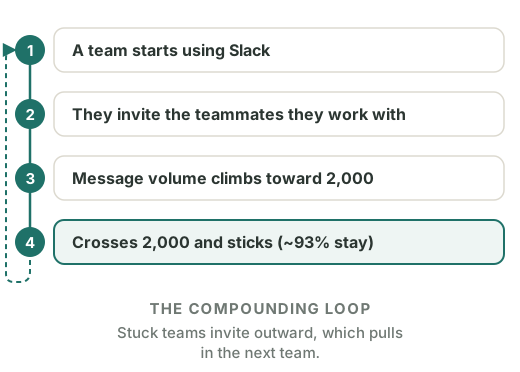
Bottom-up plus a message-based activation metric creates a loop that feeds itself:
- A person starts using Slack and invites the teammates they actually work with.
- More teammates means more messages, which moves the team toward 2,000.
- Crossing 2,000 means the team sticks, and a stuck team keeps inviting outward, into adjacent teams and, eventually, the rest of the company.
The marketing was not bolted onto the product. Using the product well was the marketing. And crucially, the loop did not stop at "the team sticks." A stuck team kept adding people, which is why the growth curve at the top of this page bent the way it did.
The loop, in the financials
If the loop is real, it should show up in the money, not just the usage charts. It does. By its 2019 IPO filing, Slack reported a net dollar retention rate of 143% Slack S-1, via Tomasz Tunguz. That means the average existing customer spent about 43% more a year later, before counting any new customers. That is the "invite outward" step of the loop expressed as revenue: teams that stuck did not just stay, they pulled in more seats. Revenue tracked it: $105M in FY2017, $221M in FY2018, and $400.6M in FY2019 Slack S-1, via Tomasz Tunguz.
The numbers that followed
| Metric | Figure | As of | Source |
|---|---|---|---|
| Daily active users | 2.7M | Apr 2016 | TechCrunch |
| Daily active users | 10M+ | Jan 2019 | Slack S-1 |
| Paid seats / customers | 800k seats | Apr 2016 | TechCrunch |
| Paid customers | 88,000 | Jan 2019 | Slack S-1 |
| Net dollar retention | 143% | Jan 2019 | Slack S-1 |
| Revenue (FY2019) | $400.6M | Jan 2019 | Slack S-1 |
| Activation threshold | 2,000 messages | founder interview | First Round Review |
| Retention past activation | ~93% | founder interview | First Round Review |
Usage and activation figures are Slack-reported. Revenue, customer counts, and retention are from the audited S-1. Every row maps to a verified row in our evidence ledger.
What you can't copy
This is where most teardowns mislead you. Slack's growth was real, but it did not start from zero. Before you copy the playbook, be honest about the tailwinds Slack had that you probably do not:
- A founder with a track record and a press network. Butterfield had already built and sold Flickr to Yahoo Wikipedia. The 2013 preview got covered because reporters already took his calls. Your invite-only launch will not manufacture 8,000 requests on reputation alone.
- Funding runway from a failed game. Slack was a pivot from Tiny Speck's game Glitch, which had raised venture money. The team had salaries, a working internal tool, and time to get the product right before monetising Wikipedia.
- A pre-built, senior engineering team. The product was polished on day one because the people building it had already shipped hard software together.
None of that invalidates the tactics below. It just means the wedge, the activation focus, and the pricing are copyable, while the launch spike rode advantages you have to earn another way (usually community and helpfulness over months, not a press splash).
Where the play has limits
Bottom-up is not a universal answer. Pure team-led adoption struggles to close the largest accounts on its own, which is why Slack layered on an enterprise sales motion as it grew, and why 575 customers over $100k in ARR came to represent about 40% of revenue by 2019 Slack S-1. The loop gets you in the door and expands seats; it does not negotiate a seven-figure security review. And a bottom-up moat is only as strong as the switching cost: when a bundled competitor (Microsoft Teams) gave the same category away inside an existing enterprise agreement, "already free in your Office deal" competed directly with Slack's land motion. Bottom-up wins attention; it does not make you immune to distribution.
What you can steal
- Pick a wedge that does not need permission. Sell to the smallest unit that can adopt you on its own. A team can say yes on a Tuesday; a company takes a quarter. See the first-customers playbooks for the motions that fit a pre-revenue product.
- Find your 2,000-message number. Identify the single behaviour that predicts a customer will stay, then measure the threshold where the odds flip. Our benchmarks hub is where activation and retention numbers get compared.
- Build onboarding backwards from that number. Every early prompt should push the user toward the activation behaviour, not toward a feature tour.
- Align pricing with value delivered. Charging only for active users removed the "paying for dead seats" objection. Ask what your equivalent of Fair Billing is.
- Make inviting feel like using. If pulling in the next person is a natural part of getting value, growth stops being a separate budget line.
Primary sources
- Josh Constine, "Slack's rocketship...," TechCrunch, 1 April 2016. 2.7M DAU, 800k paid seats, 3.5x YoY, $3.8B valuation. techcrunch.com
- "From 0 to $1B: Slack's Founder Shares Their Epic Launch Strategy," First Round Review. The 2,000-message activation quote, the 93% figure, and the preview invite requests. review.firstround.com
- Slack Technologies Form S-1, SEC, 2019. 10M+ DAU, 88k paid customers, 143% net dollar retention, $400.6M FY2019 revenue. sec.gov
- Tomasz Tunguz, "Benchmarking Slack's S-1." Revenue trajectory and the 143% NDR read. tomtunguz.com
- Slack, "Fair Billing Policy." The 28-day active-user billing rule. slack.com
- "Slack (software)" and "Stewart Butterfield," Wikipedia. Timeline: Flickr, Tiny Speck, Glitch, preview, launch, listing. wikipedia.org
Every load-bearing number above maps to a row in our evidence ledger with a primary-source URL, a date, and a confidence grade. Usage and activation figures are self-reported by Slack; revenue, customer counts, and retention are from the audited S-1. Where a number is derived (the 2015 DAU) or self-reported, we say so. If we could not verify a figure against a primary source, it is not on this page.
Frequently asked questions
- How did Slack get its first customers?
- Through an invite-only preview in August 2013 that drew 8,000 invitation requests on day one and 15,000 within two weeks, plus a bottom-up motion where individual teams adopted Slack and spread it sideways across their company before any procurement conversation.
- What was Slack's activation metric?
- Messages sent. Co-founder Stewart Butterfield said any team that has exchanged 2,000 messages has really tried Slack, and about 93% of teams that pass that threshold keep using it. Onboarding was built to get teams to 2,000 as fast as possible.
- Is Slack product-led growth?
- Yes. Slack is a classic bottom-up, product-led company: individual teams adopted it on their own and it spread across the organisation before sales got involved. The expansion shows up in its 143% net dollar retention at IPO (2019 S-1).
- How fast did Slack grow?
- Daily active users went from roughly 0.77M in April 2015 (derived from Slack's stated 3.5x year-over-year growth) to 2.7M in April 2016, to more than 10M by January 2019. Revenue grew from $105M (FY2017) to $221M (FY2018) to $400.6M (FY2019).
- Did Slack really grow 'from 16k to 2.7M users'?
- No. The 16k figure is roughly 15,000 invitation requests at the 2013 preview, not daily active users. The verified daily-active-user figure is 2.7M as of April 2016 (TechCrunch), rising to more than 10M by 2019 (S-1).
Related teardowns
Dropbox's growth teardown: the referral program everyone misquotes
How Dropbox went from 100k to 4M users in 15 months with broken ad economics, what the two-sided referral program actually paid, and which parts of the loop you can copy.
ProjectionLab's growth teardown: the continuity gate and the vouch you can't buy
How a solo developer reached $1M ARR with no funding, no ads and no SEO team by giving away the whole engine and charging only to save your work, and which of those mechanics survive the move to B2B.
Calendly's growth teardown: the link is the ad
How Calendly turned a single scheduling link into a viral loop, bootstrapped to a $3B valuation on $550k, and reached 86% of the Fortune 500.
Last fact-checked 2026-07-05. Every figure on this page maps to a primary source in our evidence ledger.