PLG vs sales-led growth: which fits your product?
Product-led growth lets the product sell; sales-led growth lets people sell. What each means, when each fits, and why most successful B2B companies run both.
Product-led growth (PLG) means the product drives acquisition, conversion, and expansion: users sign up, experience value, and often pay before talking to sales. Sales-led growth (SLG) means salespeople drive the motion, through outbound, demos, and negotiated contracts. Most successful B2B companies are hybrid: PLG to get in, sales to expand.
"PLG vs sales-led" is usually framed as a fight, but it is really a question of fit, and for most companies the answer is both. Here is what each motion is, when it works, and why the winners combine them.
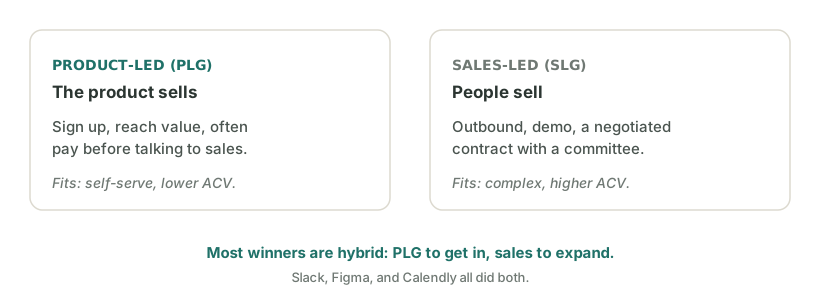
The two motions
- Product-led (PLG): the product does the selling. Someone signs up, reaches value on their own, and often pays before a salesperson is involved. Growth spreads through usage and sharing, so the marketing and the product are the same thing.
- Sales-led (SLG): people do the selling. A salesperson runs outbound, gives a demo, handles objections, and negotiates a contract. Growth comes from a repeatable sales process, not from the product spreading on its own.
When each fits
PLG tends to win when the product is self-serve, the price is low enough to buy without a committee, the adopter is an individual, and the "aha" is fast. Sales-led tends to win when the product is complex to adopt, the deal is large, the buyer is a committee, or procurement and security reviews are unavoidable. A blunt test: if a new user can get real value alone in a few minutes, PLG has something to ride on. If they cannot, a sales-assisted motion usually converts better. This is also where PQLs come in, because they tell a PLG company which self-serve users are worth a human touch.
Why most winners are hybrid
The most successful B2B companies do not pick one. They use PLG to land cheaply and sales to expand. The growth teardowns show the pattern repeatedly: Slack, Figma, and Calendly all grew bottom-up through the product, then layered an enterprise sales motion on top to close and secure their largest accounts. Slack's own S-1 shows the pattern: 575 customers paying over $100k a year came to represent about 40% of revenue by 2019 Slack S-1 — and accounts that size are not closed by a self-serve signup flow. The loop gets you in the door; sales turns a foothold into a seven-figure contract.
Related
Learn what a PQL is (the bridge between PLG and sales), read founder-led sales for the earliest sales motion, and see the growth teardowns for hybrid motions in practice.
Frequently asked questions
- What is product-led growth (PLG)?
- A go-to-market motion where the product itself drives acquisition, conversion, and expansion. Users sign up, experience value, and often pay before ever talking to a salesperson. Slack, Figma, and Calendly are classic examples: adoption spreads through using and sharing the product.
- What is the difference between PLG and sales-led growth?
- In PLG the product sells itself through self-serve signup and usage. In sales-led growth (SLG) salespeople drive the motion through outbound, demos, and negotiated contracts. PLG fits self-serve, lower-price products with an individual adopter; SLG fits complex, higher-price products bought by a committee.
- Which is better, PLG or sales-led?
- Neither universally. It depends on your price, complexity, and buyer. Most successful B2B companies are hybrid: they use PLG to land individual teams cheaply and a sales motion to expand those footholds into large contracts.
- Can you do both PLG and sales-led?
- Yes, and most winners do. Slack, Figma, and Calendly all grew bottom-up through the product, then layered enterprise sales on top to close large accounts. The product gets you in the door; sales expands the biggest deals.
- When should I use sales-led instead of PLG?
- When the product is complex to adopt, the price is high, the buyer is a committee, or procurement and security reviews are required. If a user cannot get real value on their own in minutes, a pure PLG motion will struggle and a sales-assisted one usually wins.
Related guides
ABM vs demand generation: which should you run?
Demand generation casts a wide net and qualifies leads down a funnel. ABM starts with a named account list and works it in reverse. What the actual dated studies say (not the recycled 87% stat), and why most B2B teams now run both.
What is a reverse trial?
A reverse trial gives new users full premium access for a set window, then downgrades them to a free tier instead of locking them out. How it works, who runs it, what it converts at, and when to use it.
What is usage-based pricing?
Usage-based pricing charges for what customers consume — API calls, gigabytes, events, credits — so the bill scales with usage, not headcount. How it works, why it wins on expansion (~120% vs ~110% NRR), and its real tradeoff.
Last fact-checked 2026-07-05. Every figure on this page maps to a primary source in our evidence ledger.