What is usage-based pricing?
Usage-based pricing charges for what customers consume — API calls, gigabytes, events, credits — so the bill scales with usage, not headcount. How it works, why it wins on expansion (~120% vs ~110% NRR), and its real tradeoff.
Usage-based pricing charges customers for what they actually consume — API calls, gigabytes stored, events processed, messages sent, credits burned — so the bill scales with usage instead of headcount. It ties price to the value a customer pulls from the product, and it expands automatically as they grow, which is the reason it has taken share from per-seat pricing every year for a decade.
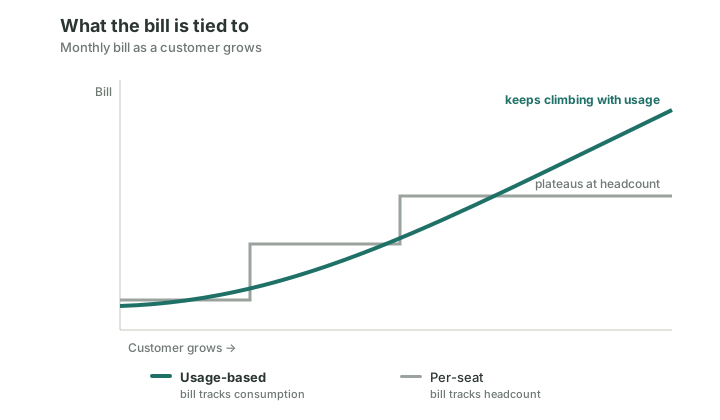
The pricing question that quietly reshaped B2B SaaS is not free trial versus freemium; it is how you meter the bill once someone pays. Usage-based pricing is one answer, and it comes down to a single choice: what does the bill track?
How it works: the metric is the model
Under usage-based pricing you pick a unit of consumption and charge for it: API calls, gigabytes, events, seats-hours, messages, compute, or credits. That metric is the entire model, because it decides two things at once — what the customer pays for, and what they optimize. A customer who grows with you pays more without renegotiating a contract, and a customer who uses less pays less, which feels fair and reduces the pressure to churn. The craft is choosing a metric the customer understands, accepts as fair, and can roughly predict.
Why it took share: expansion
The strongest argument for usage-based pricing is expansion. Companies with usage-based models report around 120% net revenue retention, versus about 110% for subscription-only peers OpenView / High Alpha, 2024. That gap looks small until you read it as net expansion: existing customers grow spend about 20% a year net under usage-based, versus about 10% under subscription — roughly double, and it compounds. Crucially, it happens without a sales-led upsell: the customer simply uses more and the meter moves. No surprise, then, that adoption keeps climbing — about 38% of SaaS companies used some form of usage-based pricing in 2026, up from roughly 27% in 2021 OpenView / High Alpha. These are survey benchmarks, so treat them as directional rather than precise, but the direction has held for years.
The tradeoff: expansion vs predictability
Usage-based pricing is not free upside. Because the bill floats with consumption, your revenue is harder to forecast, which makes board planning and sales compensation trickier and can unsettle a buyer who wants a fixed number to take to procurement. Per-seat's predictability is a real feature, not just inertia: a CFO can budget it, a rep can quote it, and a customer knows the bill before they commit. Usage-based also demands honest metering — a metric the customer accepts as fair and can foresee — or it breeds bill shock and churn. This is why the hybrid model wins so often: a committed base (a platform fee or a seat bundle) that keeps revenue predictable, plus a usage component on top that lets only the upside float. Most companies that adopt usage-based pricing land here rather than on pure metering.
A real fair-metering example
Slack is a clean example of metering that customers see as fair. Under its Fair Billing Policy, a workspace pays only for members who were actually active — someone who took an action within a 28-day window — and inactive members are credited back on a prorated basis Slack. It is not pure usage-based pricing (Slack still sells per active user), but it borrows the core idea: tie the bill to real usage so the customer never pays for value they did not get. That fairness removes a reason to churn and makes the meter feel earned rather than extractive.
How to think about it for your product
Related
For the full head-to-head, the NRR chart, and when each fits, see usage-based vs per-seat pricing. See PLG vs sales-led for the go-to-market motion that usually pairs with each model, and the growth teardowns for pricing mechanics in practice, including Slack's fair billing and Calendly's seat-based expansion.
Sources
- "SaaS Benchmarks 2024," OpenView / High Alpha. highalpha.com
- "Slack's Fair Billing Policy," Slack Help Center. slack.com
Frequently asked questions
- What is usage-based pricing?
- Usage-based pricing charges customers for what they actually consume, such as API calls, gigabytes stored, events processed, messages sent, or credits burned. The bill tracks how much value a customer pulls from the product, so it scales with usage rather than with the number of seats or a flat subscription.
- What is the difference between usage-based and per-seat pricing?
- Per-seat pricing charges a fixed price for each user or license, so the bill scales with headcount and is easy to forecast. Usage-based pricing charges for consumption, so the bill scales with how much the customer uses and grows automatically as they grow. Per-seat is simpler to budget; usage-based ties price more directly to value delivered.
- Why is usage-based pricing popular?
- Because of expansion. Usage-based companies report around 120% net revenue retention versus about 110% for subscription-only peers, meaning existing customers grow their spend roughly twice as fast without a sales-led upsell. Adoption has climbed to about 38% of SaaS companies in 2026, up from roughly 27% in 2021.
- What is the downside of usage-based pricing?
- Revenue is harder to forecast, because the bill floats with consumption. That complicates board planning and sales compensation, and it can spook a buyer who wants a fixed number for procurement. It also needs a metric the customer sees as fair and can predict, or it breeds bill shock and churn. This is why most adopters run a hybrid rather than pure metering.
- What is hybrid pricing?
- Hybrid pricing combines a fixed base (a per-seat bundle or a platform fee) with a usage-based component on top. It keeps a predictable committed floor while letting the upside float with consumption. Most companies that adopt usage-based pricing land on a hybrid, because pure metering makes revenue too hard to forecast.
Related guides
ABM vs demand generation: which should you run?
Demand generation casts a wide net and qualifies leads down a funnel. ABM starts with a named account list and works it in reverse. What the actual dated studies say (not the recycled 87% stat), and why most B2B teams now run both.
What is a reverse trial?
A reverse trial gives new users full premium access for a set window, then downgrades them to a free tier instead of locking them out. How it works, who runs it, what it converts at, and when to use it.
Free trial vs freemium vs reverse trial: which converts?
Free trials convert highest per signup (opt-in ~18.5%, opt-out ~48.8%), freemium lowest (~2-5%) but at scale, and reverse trial is the hybrid. How to pick, with sourced numbers.
Last fact-checked 2026-07-11. Every figure on this page maps to a primary source in our evidence ledger.