PQL conversion rate benchmarks (and how PQLs beat MQLs)
Product-qualified leads convert to paid at ~8-20%, and free trials that use PQL scoring convert ~2.8x higher than those that don't. The benchmarks, and why usage beats marketing signals.
If you run a free trial or a freemium product, the single highest-leverage thing you can measure is which users are actually ready to buy. That is what a product-qualified lead is, and PQLs convert dramatically better than the marketing-qualified leads most sales teams still chase. Here are the benchmarks and why the difference is so large.
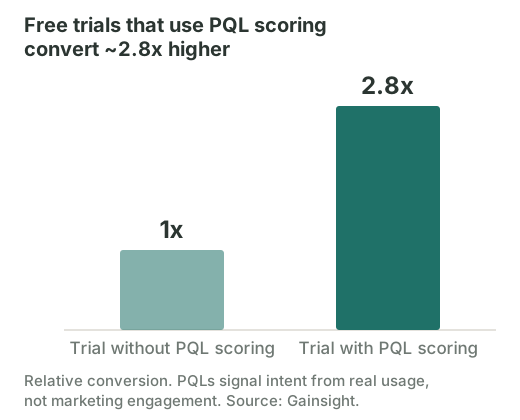
Product-qualified leads convert to paid at roughly 8 to 20%, and 25 to 40% for the best products. More importantly, free trials that use PQL scoring convert about 2.8x higher than those that don't, because a PQL is qualified by real product usage, not marketing engagement. For comparison, the older MQL-to-SQL step runs about 18 to 22%.
The benchmark table
| Metric | Typical range | Source |
|---|---|---|
| PQL to paid | ~8-20% (exceptional 25-40%) | analyst reports |
| Uplift from using PQL scoring | ~2.8x vs no PQL scoring | Gainsight |
| MQL to SQL (for comparison) | ~18-22% (top 25-35%) | analyst reports |
Aggregated analyst benchmarks (graded Medium in our evidence ledger). PQL and MQL are different funnel stages; the comparison is illustrative, not apples-to-apples.
Why usage beats marketing signals
An MQL is someone marketing thinks might buy, based on engagement: they downloaded a guide, came to a webinar, opened your emails. A PQL is someone the product knows might buy, based on what they actually did: they hit the core feature, invited their team, imported real data. The second signal is far stronger, because using the product is a much better predictor of buying it than reading about it. That is why free trials scored with PQLs convert about 2.8x higher Gainsight.
How to define your PQL
A PQL is just the set of in-product behaviors that predict a user will stick and pay. The canonical example is from Slack: teams that exchanged 2,000 messages had "really tried it," and about 93% kept using it, so 2,000 messages became the activation threshold the whole onboarding aimed at. Your PQL is your version of that number. Find the behavior that separates the users who stay from the ones who churn, set the threshold, and route users who cross it to a human or a well-timed upgrade prompt.
Related
See free trial and freemium conversion rates for the models PQLs help convert, and the growth teardowns for activation metrics (the raw material of a PQL) in practice.
Sources
- "Benchmark: Product Qualified Lead (PQL) Conversion Rates," Gainsight. The PQL uplift and benchmark ranges. gainsight.com
- MQL-to-SQL conversion benchmarks (for comparison), from B2B SaaS funnel analyses. firstpagesage.com
PQL and MQL benchmarks vary by source and by how each company defines a "qualified" lead. We aggregate analyst sources, present ranges, and grade them Medium in our evidence ledger. The 2.8x uplift is a Gainsight benchmark figure. Your own product's activation data is the real definition of a PQL.
Frequently asked questions
- What is a good PQL to paid conversion rate?
- Roughly 8 to 20%, with exceptional products reaching 25 to 40% when the trial delivers clear value. The bigger point: free trials that use product-qualified-lead scoring convert to paid about 2.8x higher than trials that do not, because PQLs are based on real product usage.
- What is the difference between a PQL and an MQL?
- An MQL (marketing-qualified lead) is qualified by marketing engagement, like downloading a whitepaper or opening emails. A PQL (product-qualified lead) is qualified by real product usage, like reaching a key feature or inviting teammates. PQLs signal buying intent far more reliably because the person has actually used the product.
- Do PQLs convert better than MQLs?
- Yes. PQL-based approaches outperform traditional MQL funnels because they are grounded in actual usage rather than marketing engagement. For comparison, MQL-to-SQL conversion runs about 18 to 22% (top performers 25 to 35%), but that is a different, earlier funnel stage.
- How do I define a PQL?
- Find the in-product behaviors that predict a user will stick and pay, then score trial and free users against them. Slack's classic example was teams that sent 2,000 messages, past which about 93% kept using it. Your PQL is your equivalent of that threshold.
- Why do PQLs matter for product-led growth?
- In product-led growth the product itself generates the buying signal, so PQLs are how you know which self-serve users are worth a human touch. They convert far higher than cold or marketing-sourced leads, which is why PLG companies build sales around PQLs rather than form fills.
Related benchmarks
Activation rate benchmarks (B2B SaaS)
What's a good activation rate? There is no trustworthy cross-company benchmark, and here's the evidence why. Every product defines activation differently, so the figures circulating come from vendor pages with no method behind them.
Net revenue retention benchmarks (B2B SaaS)
What's a good NRR? The two named surveys that publish a figure both land near 101-102% for private B2B SaaS, not the 106-108% that circulates. Dated, sourced, with the scope attached to each number.
Free trial conversion rate benchmarks (B2B SaaS)
What's a good free trial to paid conversion rate? Opt-in trials convert at a ~18.5% median; opt-out (card required) at ~48.8%. Dated, sourced ranges, with the honest caveats.
Last fact-checked 2026-07-05. Every figure on this page maps to a primary source in our evidence ledger.