Usage-based vs per-seat pricing: which should you choose?
Per-seat charges per user; usage-based charges per consumption. Usage-based companies post higher net revenue retention (~120% vs ~110%). When each fits, and why many run both.
Per-seat pricing charges per user, so your bill scales with headcount: simple, predictable, but it caps expansion at how many people log in. Usage-based pricing charges per consumption, so it scales with value delivered and expands automatically, but revenue is harder to forecast. Usage-based companies post higher net revenue retention (around 120% vs 110%). Many now run a hybrid: a committed base plus usage on top. Choose by whether your value grows with users or with usage.
The pricing debate that has quietly reshaped B2B SaaS is not free trial vs freemium; it is how you meter the bill once someone pays. Per-seat ruled the last decade. Usage-based pricing has taken share every year since, for one measurable reason. Here is how each works, the number that explains the shift, and how to choose.
The two models, and the hybrid
- Per-seat: you pay a fixed price per user or license. Ten seats cost ten times one seat. The bill is predictable and easy to budget, and it is simple to sell, which is why it dominated. Its ceiling is headcount: once everyone who will use the product has a seat, expansion stops.
- Usage-based: you pay for what you consume, such as API calls, gigabytes stored, events processed, messages sent, or credits burned. The bill tracks how much value the customer pulls from the product, so a customer who grows with you pays more without renegotiating.
- Hybrid: a committed base (a platform fee, or a bundle of seats) plus a usage component on top. Most companies that adopt usage-based pricing land here, because it keeps a predictable floor while letting the upside float with consumption.
The number that explains the shift
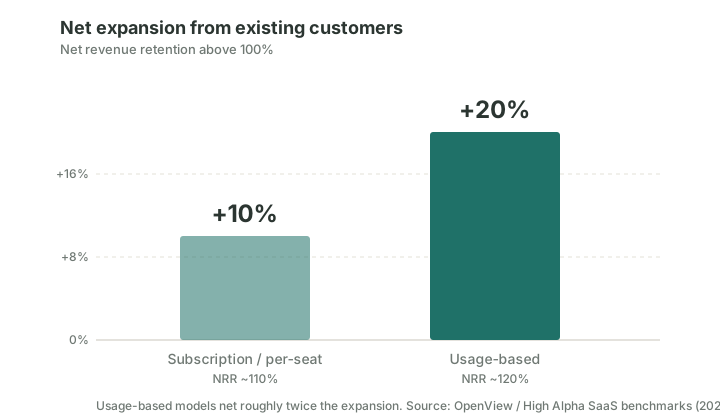
The strongest argument for usage-based pricing is expansion. Companies with usage-based models report around 120% net revenue retention, versus about 110% for subscription-only peers OpenView / High Alpha, 2024. That gap looks small until you read it as net expansion: existing customers grow spend about 20% a year net under usage-based, versus about 10% under subscription, roughly double. And it compounds, because it happens without a sales-led upsell: the customer simply uses more and the meter moves. It is no surprise, then, that adoption keeps climbing: about 38% of SaaS companies used some form of usage-based pricing in 2026, up from roughly 27% in 2021 OpenView / High Alpha. These are survey benchmarks, so treat them as directional rather than precise, but the direction has been consistent for years.
The tradeoff: expansion vs predictability
Usage-based pricing is not free upside. Because the bill floats with consumption, your revenue is harder to forecast, which makes board planning and sales compensation trickier and can spook a buyer who wants a fixed number to take to procurement. Per-seat's predictability is a real feature, not just inertia: a CFO can budget it, a rep can quote it, and a customer knows the bill before they commit. Usage-based also needs honest metering (a metric the customer accepts as fair and can foresee) or it breeds bill shock and churn. This is why the hybrid model wins so often: it keeps a predictable committed base and lets only the upside float.
How to choose
- Does your value scale with users or with usage? If the product is worth more the more people collaborate in it (a CRM, a design tool, a shared workspace), per-seat maps cleanly to value. If value scales with volume (an API, data platform, messaging, or infrastructure), usage-based maps better, and per-seat will leave money on the table or cap your growth.
- Who is your buyer, and do they need a predictable bill? Selling to procurement or a budget-holder who needs a fixed line item favors per-seat or a hybrid with a committed floor. Bottom-up adopters who want to start small and grow favor usage-based.
- Can you meter something the customer sees as fair? Usage-based only works if the metric is one the customer understands, accepts, and can roughly predict. If the fairest metric is invisible or volatile, a hybrid or per-seat avoids bill shock.
If you are unsure, a hybrid (a committed base plus usage) captures most of the expansion upside while keeping a predictable floor, which is exactly why most usage-based companies run one.
Related
This is the metering side of pricing; for the free-to-paid side see free trial vs freemium vs reverse trial. See PLG vs sales-led for the motion that usually pairs with each model, and the growth teardowns for pricing mechanics in practice, including Slack's per-active-user fair billing and Calendly's seat-based expansion.
Frequently asked questions
- What is the difference between usage-based and per-seat pricing?
- Per-seat pricing charges a fixed price for each user or license, so your bill scales with headcount. Usage-based pricing charges for what customers actually consume (API calls, gigabytes, events, credits), so the bill scales with usage. Per-seat is simpler to forecast; usage-based ties price more directly to the value delivered.
- Is usage-based pricing better than per-seat?
- Not universally, but it has one clear edge: expansion. Usage-based companies report around 120% net revenue retention versus about 110% for subscription-only peers, because revenue grows automatically as customers use more, without a sales-led upsell. The tradeoff is that usage-based revenue is harder to predict, so which is 'better' depends on whether you value expansion or predictability more.
- How many SaaS companies use usage-based pricing?
- About 38% of SaaS companies used some form of usage-based pricing as of 2026, up from roughly 27% in 2021 and 34% in 2023, per OpenView and High Alpha's annual benchmarks. Adoption is rising, but per-seat and hybrid models still dominate, and most usage-based companies pair usage with a platform fee rather than going purely metered.
- When does per-seat pricing make more sense?
- Per-seat fits when value scales with the number of people using the product (collaboration tools, CRMs, seats-based workflows), when buyers want a predictable bill they can budget, and when your buyer is procurement, which prefers fixed line items. It is also simpler to sell and to forecast, which matters a lot earlier on.
- What is hybrid pricing?
- Hybrid pricing combines a fixed base (often per-seat or a platform fee) with a usage-based component on top. It gives you the predictability of a committed floor plus the automatic expansion of usage. Most companies that adopt usage-based pricing run a hybrid rather than a purely metered model, because pure metering makes revenue hard to forecast.
Related guides
ABM vs demand generation: which should you run?
Demand generation casts a wide net and qualifies leads down a funnel. ABM starts with a named account list and works it in reverse. What the actual dated studies say (not the recycled 87% stat), and why most B2B teams now run both.
What is a reverse trial?
A reverse trial gives new users full premium access for a set window, then downgrades them to a free tier instead of locking them out. How it works, who runs it, what it converts at, and when to use it.
What is usage-based pricing?
Usage-based pricing charges for what customers consume — API calls, gigabytes, events, credits — so the bill scales with usage, not headcount. How it works, why it wins on expansion (~120% vs ~110% NRR), and its real tradeoff.
Last fact-checked 2026-07-08. Every figure on this page maps to a primary source in our evidence ledger.