How to get your first 10 B2B customers
Not from ads or funnels. Your first 10 B2B customers come from your network, a precise outreach list, communities, and doing things that don't scale. With real, sourced examples.
The advice most founders reach for to get their first customers, run ads, build a funnel, "do content," is exactly wrong at 10 customers. Those are ways to scale a channel that already works. You do not have one yet. Your first 10 customers are recruited by hand, one conversation at a time, and the founders whose stories became famous all did the same unglamorous things. Here is where the first 10 come from, with real examples.
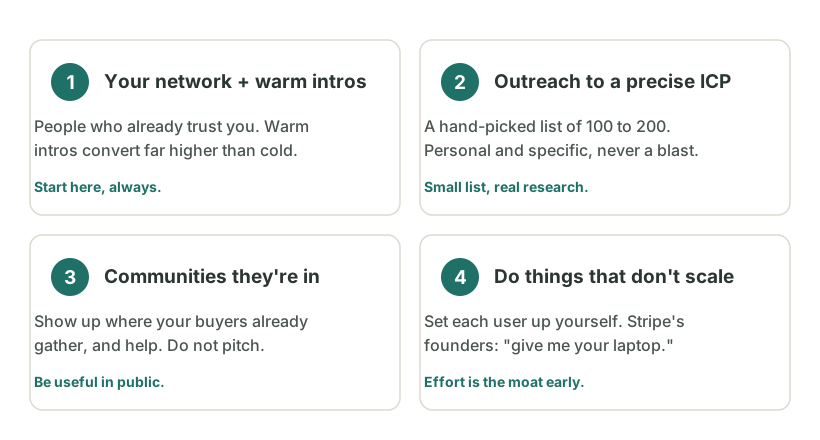
Your first 10 B2B customers come from people who already trust you (warm intros convert far higher than cold), direct outreach to a hand-picked list of 100 to 200 of exactly the right people, being useful in the communities where your buyers already are, and doing things that don't scale, like setting each user up yourself. You recruit the first 10 manually. Nobody is coming until you go get them.
The uncomfortable truth
Paul Graham put it plainly in his 2013 essay that became startup canon: "The most common unscalable thing founders have to do at the start is to recruit users manually. Nearly all startups have to. You can't wait for users to come to you. You have to go out and get them" Paul Graham, Do Things That Don't Scale.
This is uncomfortable because it does not look like "building a company." It looks like sending individual messages and having awkward calls. But the manual phase is not a detour before the real growth. It is where you find out what people will actually pay for, which is the only thing that makes the later scaling possible.
Where the first 10 actually come from
1. Your network and warm introductions
The fastest first customers are people who already trust you, or who trust someone willing to introduce you. Warm introductions convert several times higher than cold outreach, which is why nearly every founder starts here Lenny's Newsletter. Notion's first users were reportedly friends, family, and fellow San Francisco founders, some reached through their investors Lenny's Newsletter. Make a list of everyone you know who has the problem, or who knows people who do, and ask for a 15-minute conversation, not a sale.
2. Manual outreach to a precise ICP
When the network runs thin, go direct, but stay narrow. A hand-picked list of 100 to 200 exactly right contacts, each message personal and specific, will teach you more than a blast to thousands. Figma's Dylan Field cold-messaged influential designers he found with a script, showing them the product directly Lenny's Newsletter. Goldcast sent 200 cold emails split between two audiences, trade-show organizers and field marketers; only the field marketers responded, which is how they found where the real demand was Lenny's Newsletter. That is the hidden value of a small, deliberate list: the non-responses are data too.
3. Communities where your buyers already gather
You do not have to invent an audience. Your buyers already gather somewhere, a subreddit, a Slack group, a LinkedIn niche, an industry forum. Show up and be useful. Stripe's founders spent their early days where developers were, at hackathons and events, sitting with people and solving their problems rather than pitching Stripe early story. Helping first earns the trust that a cold pitch never will. The rule: contribute ten times more than you promote.
4. Do things that don't scale
This is the one founders skip, and it is the most important. When someone shows interest, remove every ounce of friction by doing the work for them. The canonical example is the "Collison installation": when anyone agreed to try Stripe, the founders would say "Right then, give me your laptop" and set them up on the spot Paul Graham. Airbnb's founders went door to door in New York, signing up hosts and improving their listings by hand Paul Graham. The effort is not a stopgap. It is your unfair advantage, because a big competitor will not do it and it teaches you exactly where the product breaks.
A concrete two-week plan
You do not need a strategy deck. You need a list and two weeks:
- Write down who exactly has this problem. One sentence, specific. "Solo founders using spreadsheets to invoice clients," not "small businesses." Vague ICP is why outreach fails.
- List 20 warm contacts who fit or who can introduce you. Ask each for a 15-minute call about the problem, not a demo.
- Build a 100-person cold list of the exact ICP. Research each enough to write one true, specific sentence about them.
- Find the two communities where they gather. Spend a week answering questions there, linking to nothing.
- For anyone who shows interest, do the unscalable thing. Get on a call, set them up yourself, fix their first problem live.
Ten real conversations will teach you more than any amount of planning.
What not to do
- Do not run ads or build a funnel. You are optimizing a channel that does not exist yet.
- Do not mass-blast cold email. A thousand generic emails burns your domain and teaches you nothing. A hundred researched ones tell you where demand is.
- Do not hide behind building. The instinct to add one more feature before talking to anyone is the most common way to never get a first customer.
Where to go next
The first 10 are a founder-led motion by definition. For how founders out-sell salespeople early and when to hand off, and for the cold-email specifics (a real reply-rate reality check and templates), see the rest of the first-customers playbooks. For proof that even giant companies started with manual, unscalable effort, read the growth teardowns: Stripe's laptop trick and Slack's hand-built early team are the same move at a different scale.
Sources
- Paul Graham, "Do Things that Don't Scale," 2013. The manual-recruitment principle, the Collison installation, and the Airbnb door-to-door example. paulgraham.com
- "How to win your first 10 B2B customers," Lenny's Newsletter. Warm-intro conversion, the Figma, Notion, and Goldcast examples. lennysnewsletter.com
- "The First Few: Stripe," Just Go Grind, and John Collison's "~50 users after two years." justgogrind.com · startuparchive.org
The core principle and the Stripe and Airbnb examples are from Paul Graham's essay, a primary source. The Figma, Notion, and Goldcast examples are recounted in Lenny's Newsletter and we attribute them as such rather than stating them as first-hand fact. The "warm intros convert higher" and reply-rate claims are directional analyst figures, graded accordingly in our evidence ledger.
Frequently asked questions
- How do I get my first 10 B2B customers?
- By hand, not through ads or funnels. The first 10 come from your own network and warm introductions, direct outreach to a hand-picked list of 100 to 200 of the right people, being genuinely helpful in communities where your buyers gather, and doing things that don't scale, like setting each user up yourself. At this stage you recruit customers manually.
- Where do first customers actually come from?
- Mostly people who already trust you. Warm introductions convert far higher than cold outreach, so founders start with their network. Notion's first users were friends, family, and fellow San Francisco founders; Figma's Dylan Field cold-messaged influential designers he found with a script. The pattern is direct, personal founder outreach, not scaled marketing.
- Should I use cold email to get my first customers?
- Yes, but a precise list of 100 to 200 well-researched contacts with personal messages, not a mass blast. The point at 10 customers is learning, not volume. Goldcast split 200 cold emails across two audiences and only one segment responded, which told them where the real demand was.
- How long does it take to get the first customers?
- Usually longer than founders expect. Stripe had only about 50 users two years after it was founded. The first 10 customers are about learning what people will actually pay for, not about hitting a scale milestone.
- What does 'do things that don't scale' mean?
- It is Paul Graham's principle that at the start you must recruit users manually and make an extraordinary, unscalable effort. Stripe's founders set people up on the spot ('give me your laptop'); Airbnb's founders went door to door in New York helping hosts. The unscalable effort is how you get the first customers and learn what to build.
Related first customers
How to find your first ICP
Your first ideal customer profile is not a template you fill in before launch. It is derived from the users who would be very disappointed without you, in their own words. The exact mechanic, from the two people who published it.
B2B cold email that books demos (with real reply rates)
Cold email still works for early B2B, but the bar is higher. The real reply-rate benchmarks, why a small list beats a blast, the deliverability basics, and a template.
From 10 to 100 customers: what actually changes
The tactics that got you your first 10 B2B customers will not get you to 100. Where the next 90 come from, and the repeatable systems you build along the way.
Last fact-checked 2026-07-05. Every figure on this page maps to a primary source in our evidence ledger.