How to find your first ICP
Your first ideal customer profile is not a template you fill in before launch. It is derived from the users who would be very disappointed without you, in their own words. The exact mechanic, from the two people who published it.
Nearly every page about ideal customer profiles hands you a template: company size, industry, job title, budget, pain points. Fill in the boxes, and you have your ICP. That approach is backwards, and it is why the ICP most founders write never survives contact with real buyers.
An ICP is not an input to your plan. It is an output of a measurement. Here is the mechanic that produces one, from the two people who published it in full.
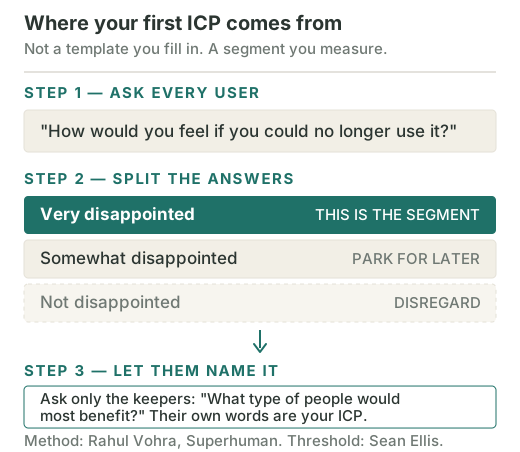
Your first ICP is not a guess you write down before launch. It is derived: survey the users you already have, keep only the ones who would be "very disappointed" without your product, and let that group describe who it is for in their own words. Then narrow to them deliberately. A small group that wants you badly beats a large group that mildly likes you.
Why the template approach fails
The template asks you to describe your ideal customer before you have met them. Whatever you write is a description of who you hope will buy, assembled from the market you imagined when you had the idea. It feels like work, it produces a document, and the document is unfalsifiable.
Worse, it tends to be too broad. Founders write "B2B SaaS companies, 50–500 employees" because a bigger number feels like a bigger opportunity. It is the opposite of what the evidence says you should do, and it leaves you with a list of thousands of companies you have no particular reason to believe in and no way to reach.
The mechanic: one question, then a lens
Rahul Vohra published Superhuman's method in detail. It starts with a survey question borrowed from Sean Ellis: "How would you feel if you could no longer use the product?" with three answers — very disappointed, somewhat disappointed, not disappointed First Round Review.
The share answering "very disappointed" is the score. Ellis's benchmark, after "benchmarking nearly a hundred startups with his customer development survey", was that "the magic number was 40%" — companies that struggled to grow "almost always had less than 40% of users respond 'very disappointed'" First Round Review.
Confidence: Med. The threshold is Ellis's own research as reported by Vohra. It is a credible rule of thumb from one body of work, not an independently published industry standard. Use it to orient, not to certify yourself.
Superhuman scored 22%. In Vohra's words: "When we started this journey in the summer of 2017, our product-market fit score was 22%." Within three quarters of work the score "nearly doubled to 58%" First Round Review.
Superhuman's own product-market fit score
But the score is not the interesting part. The interesting part is what you do with the answers.
The lens: narrow by discarding
Here is the sentence that does the actual work:
"If you instead use the 'very disappointed' group of survey respondents as a lens to narrow the market, the data can speak for itself"
That reframes the survey. It is not a report card, it is a filter. The people who would be very disappointed are your market; everyone else is noise you have been averaging into your roadmap.
And the uncomfortable half, which almost nobody quotes:
First Round Review"Politely disregard those who would not be disappointed without your product. They are so far from loving you that they are essentially a lost cause."
This is the part founders resist, because those users are real people who signed up, and some of them are loud. Disregarding them does not mean being rude or closing their accounts. It means their feedback stops steering what you build. If you keep serving everyone, you build something a large number of people want a small amount — which is precisely the trap.
| Answer | What it means | What you do |
|---|---|---|
| Very disappointed | This is your segment | Build for them, and let them define the ICP |
| Somewhat disappointed | Nearly yours, blocked by something specific | Park for later; their complaints are the roadmap |
| Not disappointed | Not your market | Politely disregard; stop optimising for them |
Let the segment name itself
Now the step that actually produces the ICP document. You do not write it. You ask the kept group a second question and read their answers back:
"We took only users who would be very disappointed without our product and analyzed their responses to the second question in our survey: 'What type of people do you think would most benefit from Superhuman?'"
The reason this works is a small piece of human behaviour worth remembering:
First Round Review"This is a very powerful question, as happy users will almost always describe themselves, not other people, using the words that matter most to them."
So the profile arrives in your customers' own vocabulary rather than yours. That matters twice over: it is a more accurate description of who to sell to, and it is the language to write your site and your outbound in, because it is demonstrably the language that resonates with the people who already love the product.
Why narrow wins
If the discarding still feels wrong, the strategic case for it is older than the survey. Paul Graham's framing:
"you can either build something a large number of people want a small amount, or something a small number of people want a large amount. Choose the latter."
He gives the reason the starting group is nearly always small: "if there were something that large numbers of people urgently needed and that could be built with the amount of effort a startup usually puts into a version one, it would probably already exist" Paul Graham, How to Get Startup Ideas.
His image for it is a well — "you can either dig a hole that's broad but shallow, or one that's narrow and deep, like a well" — and the worked example is the one nobody expects: "Microsoft was a well when they made Altair Basic. There were only a couple thousand Altair owners, but without this software they were programming in machine language."
A couple of thousand users. That is the size of a defensible starting market.
The same lesson from the outbound side
You can arrive at the same answer without a product survey, by letting the market sort two candidate profiles for you. Goldcast sent 200 cold emails split across two ICPs; only one segment responded, which revealed where the real demand was Lenny's Newsletter.
That is the cheap version of the same experiment: rather than defending the profile you wrote, put two of them in front of real buyers and let the reply rate decide. If you are running this, the cold email page covers how to build a list precise enough for the result to mean anything.
If you have no users at all
Then you cannot derive an ICP, and you should stop pretending otherwise. What you can do:
- Write the hypothesis, and label it one. One sentence: who, what they are trying to do, and why the current way is bad enough to pay to change.
- Pick the narrowest version you can actually reach. Reachability beats size at this stage. If you cannot list 100 named people who fit, the profile is too abstract to test.
- Go get the first users by hand. Paul Graham's other essay is the instruction manual: "You can't wait for users to come to you. You have to go out and get them" Paul Graham, Do Things That Don't Scale. How to get your first 10 customers is the practical version.
- Run the survey as soon as you have enough users to survey, and let it overwrite whatever you wrote in step 1.
The hypothesis is scaffolding. The derived ICP replaces it.
This story is repeated constantly, and two details drift. The intermediate score ladder often quoted — 22% to 32% or 33%, then 46%, then 56% — does not appear in the source at all, and the retellings do not even agree with each other on the second number. And the first survey was run in the summer of 2017, not April, which the source states twice. We cite the two endpoints the article actually gives, and the span it actually gives: three quarters.
What to do on Monday
- If you have users: send the one-question survey this week. You need enough responses to see a pattern, not statistical significance.
- Split the responses into the three buckets before you read any of the comments, so you are not swayed by the loudest voice.
- Read only the "very disappointed" answers to the "who would most benefit" question, and write the ICP in their words.
- Then check the rest of your funnel against it. If your activation moment and your qualification rules were built around the broad audience, they are now pointed at the wrong people.
Frequently asked questions
- How do I find my ideal customer profile?
- Derive it from evidence rather than guessing. Ask everyone who uses your product how they would feel if they could no longer use it. Keep only the people who answer 'very disappointed', then ask that group what type of person would most benefit from the product. Their answers, in their own words, are your ICP. If you have no users at all yet, you cannot derive one, so pick a narrow starting group you can reach personally and treat it as a hypothesis to be replaced.
- What is the 40% product-market fit benchmark?
- It comes from Sean Ellis, who benchmarked nearly a hundred startups with a customer development survey and found that companies which struggled to grow almost always had fewer than 40% of users answering 'very disappointed' at the thought of losing the product. Treat it as a reported rule of thumb from one person's research, not an independently published industry standard.
- Should my ICP be broad or narrow?
- Narrow. Paul Graham's framing is that you can build something a large number of people want a small amount, or something a small number of people want a large amount, and you should choose the latter. A narrow, deep market is defensible and reachable. Microsoft's first product served only a couple of thousand Altair owners.
- What do I do with customers who are not my ICP?
- Stop optimising for them. Rahul Vohra's instruction is to politely disregard the users who would not be disappointed without your product, on the grounds that they are essentially a lost cause. That does not mean being rude or cancelling their account; it means their feedback no longer steers the roadmap.
- Can I write my ICP before I have any customers?
- You can write a hypothesis, but you cannot derive an ICP without users, and you should hold what you wrote loosely. The common failure is treating a pre-launch template as settled fact and then defending it against what real buyers do. Goldcast split 200 cold emails across two candidate profiles and only one segment replied, which is how they found out which guess was right.
Related first customers
B2B cold email that books demos (with real reply rates)
Cold email still works for early B2B, but the bar is higher. The real reply-rate benchmarks, why a small list beats a blast, the deliverability basics, and a template.
How to get your first 10 B2B customers
Not from ads or funnels. Your first 10 B2B customers come from your network, a precise outreach list, communities, and doing things that don't scale. With real, sourced examples.
From 10 to 100 customers: what actually changes
The tactics that got you your first 10 B2B customers will not get you to 100. Where the next 90 come from, and the repeatable systems you build along the way.
Last fact-checked 2026-08-03. Every figure on this page maps to a primary source in our evidence ledger.