B2B cold email that books demos (with real reply rates)
Cold email still works for early B2B, but the bar is higher. The real reply-rate benchmarks, why a small list beats a blast, the deliverability basics, and a template.
Cold email still works for early B2B, but most advice about it is a decade out of date. Reply rates have fallen for years, inboxes filter harder than ever, and blasting a big list now does more harm than good. The good news: a small, precise, well-delivered list still books demos reliably. Here are the real numbers and how to run it.
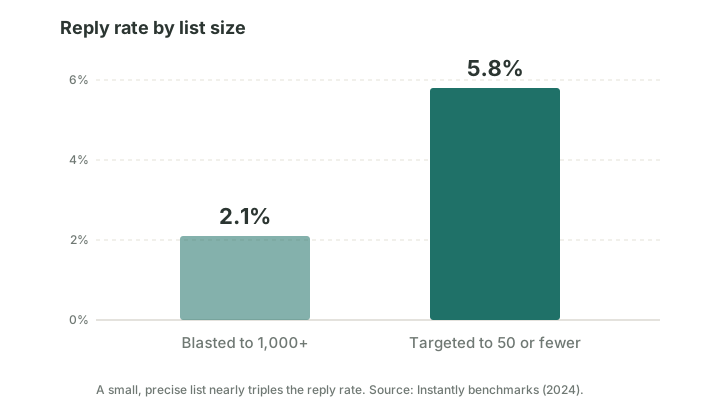
A "good" cold email reply rate is about 5 to 10%; the 2024 average is around 5%, down from 8.5% in 2019. The single biggest lever is list size: blasting 1,000+ people averages ~2.1%, while a targeted list of 50 or fewer averages ~5.8%. So send fewer, better emails to exactly the right people, fix your deliverability first, and personalize with one true, specific line.
The reality check
Set expectations before you send a single email. The average B2B cold email reply rate was around 5% in 2024, down from about 8.5% in 2019, and it has kept sliding Instantly benchmarks. A reply rate of 5 to 10% is solid, 10 to 15% is excellent, and 15%+ only happens on a tight, high-intent play. If someone promises you 30%, they are selling something. Knowing the real numbers keeps you from quitting a campaign that is actually working, or scaling one that is not.
Why a small list beats a blast
Here is the most important and most ignored fact about cold email: targeting beats volume, badly. Broad campaigns sent to more than 1,000 recipients average about a 2.1% reply rate. Campaigns sent to 50 or fewer carefully chosen prospects average about 5.8% Instantly benchmarks. A small list nearly triples your reply rate, protects your sending domain, and, as the first-10 playbook showed with Goldcast, the non-responses tell you which segment actually has the problem. Research a hundred of exactly the right people rather than blasting a thousand of the wrong ones.
Deliverability: the part that silently kills you
You can write the perfect email and still fail, because it never arrives. Roughly 17% of cold emails never reach the inbox when the sending domain lacks proper SPF, DKIM, and DMARC authentication Belkins. And the spam-complaint threshold is now around 0.1%, so even one or two complaints per thousand emails can get you filtered. Practical basics: send from a separate domain (not your main one), warm it up gradually, keep daily volume low, and set up SPF, DKIM, and DMARC before you send anything. Note that open rate is now an unreliable metric, since Apple Mail preloads tracking pixels, so judge campaigns by replies and booked calls, not opens.
What actually gets replies
Once the list is tight and the email is arriving, the message does the rest:
- One true, specific line. Reference something real about them: a recent change, a trigger, a detail from their site. Trigger and timeline hooks tend to reply best. "Congrats on the Series A, most teams your size hit X" beats "I hope this email finds you well."
- A single, small ask. Not "book a 30-minute demo." Ask a question or offer something worth 15 minutes. Lower the cost of saying yes.
- Short. If they have to scroll, you have lost. Three or four sentences.
- More than one touch. A short, polite follow-up sequence outperforms a single send. Persistence, not volume.
A template that books demos
This is a structure, not a magic script. Fill every bracket with something true and specific:
Subject: [specific thing about them], quick question

Hi [name],

Saw [specific, recent, true detail]. Teams like yours usually hit
[specific problem you solve] right around then.

We built [one plain sentence on what you do]. [One concrete proof
point, a number or a name, no hype.]

Worth a quick 15 minutes to see if it fits? If not, no worries at all.

[your name]
If you cannot fill the first bracket with something real, that person does not belong on the list. That test alone will cut a bad list in half and lift your reply rate.
What not to do
- Do not buy a list of 10,000 and blast it. You will torch your domain and learn nothing.
- Do not fake personalization. "I loved your work at [Company]" with no specifics reads worse than no personalization at all.
- Do not send from your primary domain. One bad campaign can hurt deliverability for your real email.
- Do not judge by opens. They are unreliable now. Count replies and booked calls.
Where to go next
Cold email is one channel in the first-customers mix, and usually not the first one; start with your network. See the first-10 playbook for the full order of operations, and the rest of the first-customers playbooks for founder-led sales and scaling to 100.
Sources
- "What's a Good Cold Email Reply Rate? Instantly's Benchmarks." Average reply rates, the "good" ranges, and reply rate by list size. instantly.ai
- "What are B2B Cold Email Response Rates?" Belkins. Deliverability and the SPF/DKIM/DMARC data. belkins.io
The reply-rate and deliverability figures are vendor benchmark aggregates (Instantly, Belkins), which vary by source and methodology. We grade them Medium in our evidence ledger and present them as directional, not precise. The template is a framework, not a claim. If a number could not be sourced, it is not here.
Frequently asked questions
- What is a good cold email reply rate?
- Around 5% is the 2024 average, down from about 8.5% in 2019. Roughly 5 to 10% is solid, 10 to 15% is excellent, and 15%+ is top-tier on a focused, high-intent play. List size matters enormously: broad blasts to 1,000+ recipients average about 2.1%, while highly targeted sends to 50 or fewer average about 5.8%.
- How do I get more replies to cold email?
- Shrink and sharpen the list, personalize with one true, specific line (a trigger or timeline hook tends to perform best), make a single clear ask, and fix deliverability first. Multiple personalized touches beat a single send. The counterintuitive move is to send fewer, better emails.
- Why aren't my cold emails getting delivered?
- About 17% of cold emails never reach the inbox when a domain lacks proper SPF, DKIM, and DMARC authentication. The spam-complaint threshold is around 0.1%, so even one or two complaints per thousand emails can trigger filtering. Warm up a separate sending domain and keep volume low.
- Is cold email dead for B2B?
- No, but blasting is. Reply rates have fallen for years, so generic mass sends barely work. A precise, well-researched, properly-delivered list still books demos, and for early customers it is one of the fastest ways to find where demand is.
- How many cold emails should I send to get my first customers?
- Not thousands. A researched list of 100 to 200 of exactly the right people, each message personal and specific, will teach you more than a blast and protect your domain. At this stage the goal is learning and booked conversations, not volume.
Related first customers
How to find your first ICP
Your first ideal customer profile is not a template you fill in before launch. It is derived from the users who would be very disappointed without you, in their own words. The exact mechanic, from the two people who published it.
How to get your first 10 B2B customers
Not from ads or funnels. Your first 10 B2B customers come from your network, a precise outreach list, communities, and doing things that don't scale. With real, sourced examples.
From 10 to 100 customers: what actually changes
The tactics that got you your first 10 B2B customers will not get you to 100. Where the next 90 come from, and the repeatable systems you build along the way.
Last fact-checked 2026-07-05. Every figure on this page maps to a primary source in our evidence ledger.