From 10 to 100 customers: what actually changes
The tactics that got you your first 10 B2B customers will not get you to 100. Where the next 90 come from, and the repeatable systems you build along the way.
Getting your first 10 customers and getting your first 100 are different jobs. The first 10 run on founder hustle, warm intros, and doing things that don't scale. That is exactly why they will not get you to 100: unscalable effort does not scale. The 10-to-100 stage is where you turn individual wins into a repeatable machine. Here is what changes and where the next 90 come from.
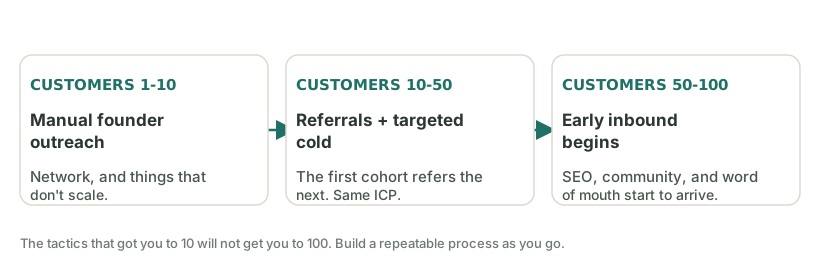
The tactics that got you to 10 will not get you to 100, because founder hustle does not scale. Customers 10 to 50 come from referrals from your first happy cohort and targeted cold outreach to that same ICP. Customers 50 to 100 start including early inbound (SEO, community, word of mouth). Along the way you build the repeatable systems, a documented sales process, tiered pricing, a first success hire, that turn heroics into a machine.
What actually changes
The first 10 customers answer a question: will anyone pay for this, and why. The next 90 answer a different one: can we get customers on purpose, repeatedly, without a miracle each time. This is the pattern-recognition phase. Your job shifts from closing deals by sheer willpower to noticing what is repeatable about how you close them, and building that into a process B2B SaaS growth guide. The uncomfortable part: what worked brilliantly at 10 can cap your growth at 100. Doing everything by hand was the right call early and becomes the bottleneck later.
Where the next 90 come from
The channels shift in a fairly consistent pattern:
- Customers 10 to 50: referrals and targeted cold. Your first cohort, if you kept them happy, is your best channel. Ask for introductions, and run targeted cold outreach to the exact ICP segment that first cohort represents. You are no longer guessing who to target; the first 10 told you B2B SaaS growth guide.
- Customers 50 to 100: early inbound begins. This is where content, community presence, and word of mouth start producing inquiries you did not initiate. It is not a flood, but the first inbound leads are a signal that the flywheel is starting to turn B2B SaaS growth guide.
Keeping the first cohort successful is what makes this work, because their referrals and word of mouth are what carry you through both stages. That is why the next hire is usually not another salesperson.
Build the machine as you go
Reaching 100 is as much about systems as channels:
- Make the sales process repeatable. Document who buys, what triggers them, the objections, and the cycle length, then hire reps to run it (see founder-led sales for the timing). A repeatable, measurable process is the difference between scaling and stalling.
- Evolve pricing. Move from bespoke, negotiated deals toward good-better-best tiers, so pricing stops being a per-deal conversation.
- Hire for retention before you over-hire for growth. A first customer-success person around 25 to 30 customers protects the cohort whose referrals you are counting on. Add a VP of Sales only after two or more reps consistently hit quota, not as a shortcut to a process you have not built.
What not to do
- Do not abandon founder-led sales too early. The founder stays close to sales well past 10 customers; hand off only when there is a documented process to hand over.
- Do not chase a new channel before the current one is repeatable. Master referrals and targeted outreach before you bet on paid or a brand-new motion.
- Do not over-hire on a fundraise. Headcount does not create a repeatable process; a repeatable process justifies headcount.
Where to go next
This is the middle of the first-customers arc. Back up to how to get your first 10 if you are not there yet, and read founder-led sales for the hiring timing that makes 10 to 100 work. The full set is in the first-customers playbooks.
Sources
- "The Founder's Survival Guide to B2B SaaS Growth." The channel shifts across the 1-to-100 stages, the customer-success timing, and the move to repeatable systems and tiered pricing. guptadeepak.com
The stage-by-stage channel pattern and the org and pricing milestones are directional guidance from B2B SaaS growth analyses, graded Medium in our evidence ledger. Real numbers vary by deal size, motion, and market; treat these as a map, not a rule.
Frequently asked questions
- What changes from the first 10 to the first 100 customers?
- The goal shifts from learning to repeatability. Customers 10 to 50 come from warm referrals from your first cohort plus targeted cold outreach to the same ICP; customers 50 to 100 start to include early inbound (SEO, community, word of mouth). You move from one-off founder heroics to repeatable systems.
- Where do customers 10 to 100 come from?
- Customers 10 to 50 come from warm referrals from your happy early customers and targeted cold outreach to the ICP that cohort represents. Customers 50 to 100 begin arriving from early inbound signals, as SEO content, community presence, and word of mouth start generating inquiries without cold initiation.
- When should I hire a customer success manager?
- Around 25 to 30 customers, once onboarding and retention start needing dedicated attention that pulls the founder away from selling. Keeping early customers successful is what turns them into the referrals that power the 10-to-50 stage.
- How do I make sales repeatable?
- Document who buys, what triggers them to buy, the objections they raise, and how long the cycle takes; move from bespoke pricing to good-better-best tiers; and hire reps to run the documented process. Repeatability, not individual heroics, is what separates a company that scales from one that stalls.
- Why won't the tactics that got me to 10 work at 100?
- The first 10 run on founder hustle and unscalable effort, which by definition does not scale. Reaching 100 requires predictable, repeatable processes and channels that generate inbound, not just outbound heroics. What works brilliantly at 10 can quietly cap your growth at 100.
Related first customers
How to find your first ICP
Your first ideal customer profile is not a template you fill in before launch. It is derived from the users who would be very disappointed without you, in their own words. The exact mechanic, from the two people who published it.
B2B cold email that books demos (with real reply rates)
Cold email still works for early B2B, but the bar is higher. The real reply-rate benchmarks, why a small list beats a blast, the deliverability basics, and a template.
How to get your first 10 B2B customers
Not from ads or funnels. Your first 10 B2B customers come from your network, a precise outreach list, communities, and doing things that don't scale. With real, sourced examples.
Last fact-checked 2026-07-05. Every figure on this page maps to a primary source in our evidence ledger.