ABM vs demand generation: which should you run?
Demand generation casts a wide net and qualifies leads down a funnel. ABM starts with a named account list and works it in reverse. What the actual dated studies say (not the recycled 87% stat), and why most B2B teams now run both.
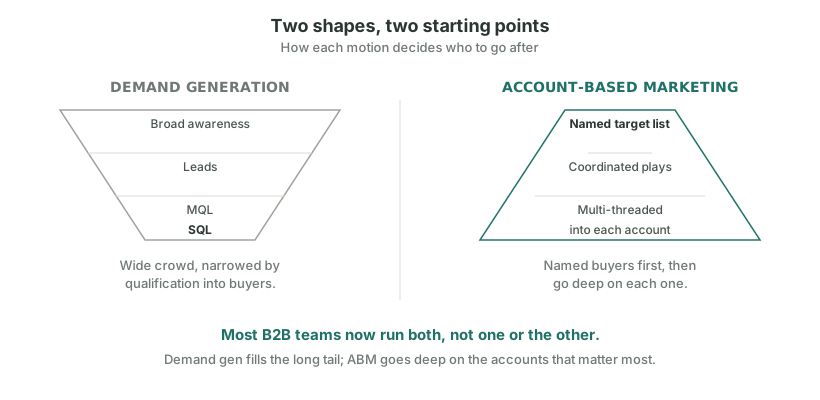
Demand generation casts a wide net: broad content and campaigns build awareness, and interested people become leads who get qualified down a funnel. Account-based marketing (ABM) works in reverse: you pick a list of named target accounts first, then marketing and sales run coordinated, personalized plays into each one. ABM fits high-value, long-cycle deals with a small addressable market; demand gen fits higher-volume, lower-touch motions. Most B2B teams now run both together rather than choosing one.
"ABM vs demand gen" gets framed as a rivalry, and most of the stats used to settle it don't hold up when you look for where they came from. Here is what each motion actually is, what has a real study behind it, and how to decide which one to run first.
The two motions
- Demand generation: you create broad awareness (content, SEO, paid, events) to pull in as many relevant people as possible, then qualify that pool down through leads → MQLs → SQLs. The funnel is the point: cast wide, filter hard, hand a smaller, warmer set to sales. A typical demand-gen funnel converts around 31% of leads to an MQL, though this varies a lot by channel and industry First Page Sage, 2025.
- Account-based marketing (ABM): you pick a defined list of target accounts before you run a single campaign, based on fit (industry, size, buying signals), not on who happened to respond. Marketing and sales then run coordinated, personalized plays — tailored content, targeted ads, direct outreach, multithreaded contact across several people at the account — aimed at that named list. There is no broad top; you start with the buyers already identified and go deep on each one.
What actually has a name and a date behind it
Search "ABM statistics" and you'll hit the same round numbers on dozens of near-identical listicles: ABM delivers "87% higher ROI," or "208% higher ROI," or drives "2-3x win rates" and "91% larger deal sizes." None of those trace to a study you can actually open, check the sample size of, or date. Tracing each one back (as of July 2026) turned up only other listicles citing each other — no named survey, no methodology, and the multiples don't even agree with each other for what is supposedly the same claim.
What does have a name and a date: a March 2023 benchmark study from Momentum ITSMA and the ABM Leadership Alliance, surveying 279 ABM heads and practitioners, found 72% said ABM delivered higher ROI than other marketing types, 84% reported pipeline growth, and 77% reported revenue growth from their ABM programs Momentum ITSMA / ABM Leadership Alliance, Mar 2023. That's a real, dated, sized survey — treat it as self-reported and directional (these are practitioners grading their own programs), not as a precise universal multiplier. The underlying takeaway is more useful than the exact percentage: most teams running ABM say it is working, but nobody has a clean, independently audited number for exactly how much better it performs than the alternative.
When each fits
- Addressable market size. If your realistic buyer universe is a few hundred to a few thousand named companies, ABM's per-account effort is affordable. If it's tens of thousands or more, you need demand gen's efficiency to reach them at all.
- Deal size and sales cycle. Large, multi-stakeholder deals with long cycles justify the custom research, content, and outreach ABM requires. Smaller, faster, more self-serve deals don't earn back that investment per account.
- Who's buying. ABM assumes a buying committee you can map and multithread into. Demand gen works even when the buyer is a single self-serve adopter, which is why it pairs naturally with product-led growth.
- What you have to spend it on. ABM is people-and-research-intensive per account before it's automatable. Demand gen scales with content and paid spend before it needs a large team. Early on, a founder can run a lightweight 1:1 ABM motion on a short list without any of demand gen's infrastructure — it's close to founder-led sales with an account list attached.
Why most teams run both
By 2026, 84% of B2B organizations reported using ABM to drive revenue, and — more tellingly — 47% said they now run ABM and demand generation as one integrated workflow rather than two separate functions, with 56% of ABM programs aimed at winning new accounts versus 28% focused on expanding existing ones Demand Gen Report, 2026 ABM Benchmark Survey. In practice, integration usually looks like this: demand gen's broad awareness and content fill the top of the funnel and surface intent signals; ABM then takes the accounts that match your ideal-customer profile out of that pool (or straight off a hand-picked list) and runs the deeper, coordinated play on them. Demand gen finds and warms the long tail; ABM goes deep on the handful of accounts where a bigger, more personalized push pays for itself. Neither replaces the other — the question isn't "which one," it's which accounts get the ABM treatment and which stay in the funnel.
Related
See PLG vs sales-led for the motion that usually pairs with demand gen, founder-led sales for the earliest, smallest version of a 1:1 ABM motion, and the PQL conversion benchmarks for more on how a demand-gen funnel actually converts.
Frequently asked questions
- What is the difference between ABM and demand generation?
- Demand generation starts wide: broad content and campaigns create awareness, and interested people become leads who get qualified down a funnel. Account-based marketing (ABM) starts narrow: you pick a list of named target accounts first, then marketing and sales run coordinated, personalized plays into each one. Demand gen finds buyers in a crowd; ABM starts with the buyers already named and goes deep.
- Is ABM better than demand generation?
- Neither is universally better; they fit different situations. ABM works best when your addressable market is a few hundred to a few thousand named accounts, deal sizes are large enough to justify custom attention, and sales cycles involve a buying committee. Demand generation works best when you need volume, your addressable market is large, and deals can close with lighter touch. Most B2B teams now run both rather than picking one.
- What percentage of B2B companies use ABM?
- Around 84% of B2B organizations reported using ABM to drive revenue as of Demand Gen Report's 2026 ABM Benchmark Survey, and 47% now run ABM and demand generation as one integrated workflow rather than two separate functions. Treat the exact figure as directional — the survey's sample size wasn't disclosed — but the trend (rising adoption, growing integration) is consistent year over year.
- Does ABM really deliver higher ROI than other marketing?
- Some dated, named surveys support this directionally — a 2023 Momentum ITSMA study of 279 ABM practitioners found 72% said ABM delivered higher ROI than other marketing types, with 84% reporting pipeline growth and 77% reporting revenue growth. But the specific '87% higher ROI' or '208% higher ROI' figures repeated across most ABM listicles could not be traced to any dated, named study — treat those as unverified rather than fact.
- Can a startup run ABM before it runs demand generation?
- Yes, in a targeted form. A pre-seed or seed startup with a short list of 10-50 ideal-fit accounts can run a lightweight 1:1 ABM motion (personalized outreach, tailored content, founder-led calls) without any demand-gen infrastructure at all. It's really just founder-led sales with an account list, which is why it fits founders before a demand-gen engine does.
Related guides
What is a reverse trial?
A reverse trial gives new users full premium access for a set window, then downgrades them to a free tier instead of locking them out. How it works, who runs it, what it converts at, and when to use it.
What is usage-based pricing?
Usage-based pricing charges for what customers consume — API calls, gigabytes, events, credits — so the bill scales with usage, not headcount. How it works, why it wins on expansion (~120% vs ~110% NRR), and its real tradeoff.
Free trial vs freemium vs reverse trial: which converts?
Free trials convert highest per signup (opt-in ~18.5%, opt-out ~48.8%), freemium lowest (~2-5%) but at scale, and reverse trial is the hybrid. How to pick, with sourced numbers.
Last fact-checked 2026-07-14. Every figure on this page maps to a primary source in our evidence ledger.